
Why Forward Deployed Engineers Are Becoming the Delivery Layer for Enterprise AI
A critical analysis of the 2026 forward deployed engineering market, including FDE job growth, compensation, required skills, enterprise AI demand and the risks behind the hiring boom.

Your mobile carrier knows who you are. We don’t. (Sponsor)

Cape is America’s privacy-first mobile carrier—unlimited talk, text, and 4G/5G data, built from the ground up with privacy and security at it’s core.
Most carriers track everything: where you go, who you call, what you do. Cape collects the minimum amount of information required to run your service, deletes call and text metadata after 24 hours, rotates your network ID to prevent tracking, defends against SIM-based attacks, and more.
Privacy shouldn’t cost more. Switch today and get $29 off for life.
Forward deployed engineering is becoming one of the clearest examples of how artificial intelligence is changing technical work without simply eliminating it.
The FDE does not spend the entire week building a general-purpose product inside a conventional engineering organization. Nor is the role limited to demonstrating software, configuring dashboards or answering technical questions during a sales process.
An FDE enters the customer’s operating environment, identifies a high-value problem, builds a working system against real data, navigates security and organizational constraints, and remains involved until the system is adopted in production.
That combination of engineering, consulting, product discovery and deployment ownership has made FDE one of the fastest-growing job categories associated with AI. LinkedIn’s January 2026 labor-market report found that forward deployed engineering roles grew 42-fold between 2023 and 2025, compared with 13-fold growth for AI engineer roles. This expansion occurred while global hiring remained considerably weaker than before the pandemic, making the FDE surge particularly notable.
The report attempts to explain who is filling these jobs, how they work and how much they earn. Its findings are directionally valuable, but some of its most dramatic numbers require careful interpretation.
The larger story is credible: enterprise AI vendors are building substantial forward deployed organizations because model access alone is not producing enough successful deployments.
The exact salary and workforce projections, however, should not be accepted without qualification.
What the 2026 FDE report claims
Another report called State of Forward Deployed Engineering 2026 published by Perspective AI in May 2026, says it surveyed 1,500 forward deployed engineers and employees in equivalent roles across 154 companies between February and April.
The sample reportedly included employees with titles such as applied AI engineer, deployment engineer, field engineer and solutions engineer, provided that their responsibilities resembled forward deployed engineering.
According to the publisher, 38% of respondents worked at frontier AI laboratories, 34% at Series B-to-D applied-AI companies, 19% at enterprise software vendors, and 9% at late-seed startups.
Its headline findings include:
Senior FDEs at frontier AI laboratories reportedly receive median total compensation of $485,000.
Staff-level FDE compensation reportedly reaches $725,000.
Respondents spend a median 47% of their time in customer-facing work and travel.
Another 31% is spent writing or reviewing code.
The remaining 22% covers internal coordination, hiring and research synthesis.
Sixty-four percent primarily deploy existing products into customer environments with substantial customization.
Seventy-eight percent expect their FDE teams to at least double during 2027.
These results describe a role that is much closer to an embedded technical founder than to a conventional customer-support engineer.
The FDE is expected to discover the problem, define the implementation, write production code, align stakeholders, measure adoption and send what was learned back into the product organization.
Why the reports need methodological caution
The report should be treated as an industry survey, not as an authoritative census of the FDE workforce.
Its published methodology identifies the sample size, company categories and survey period. It does not publicly disclose how respondents were recruited, how many people were invited, the response rate, the questionnaire, company-level sample sizes, weighting procedures or statistical confidence intervals.
That matters because FDE is not yet a standardized occupation.
A Palantir forward deployed software engineer, an Anthropic Applied AI architect, an OpenAI FDE and an enterprise solutions architect can have overlapping responsibilities, but they are not necessarily interchangeable jobs.
By normalizing several titles into one category, the survey gains coverage but also introduces classification risk. A customer-facing architect who primarily provides pre-sales advice may be counted alongside an engineer who owns months of production development.
The report also comes from a company that sells conversational customer-research technology. Its fastest-growing tooling category happens to be conversational research platforms, and the article repeatedly positions that category—and the publisher’s product—as central to FDE work.
This commercial connection does not make the survey useless. It does mean its product-specific conclusions deserve more skepticism than its broader observations about customer-facing engineering.
Compensation introduces another complication.
The report defines total compensation as annual cash, target bonuses and estimated equity valued at the company’s most recent preferred-share price. Private-company equity may be illiquid, subject to vesting, diluted in future financing rounds or ultimately worth less than the preferred financing valuation.
A reported $485,000 compensation package should therefore not be interpreted as a $485,000 salary or as guaranteed annual income.
Independent evidence confirms the hiring boom
Although the surveys’ precision is debatable, its central arguments azre supported by stronger outside evidence.
LinkedIn identifies forward deployed engineering as an emerging role designed to help organizations integrate AI into workflows and maximize returns. Its data shows 42-fold growth from 2023 through 2025.
OpenAI has turned Forward Deployed Engineering into a distinct organizational function. As of August 4, 2026, its careers search returned more than 40 matching roles across the United States, Europe, Asia, Australia and the Middle East.
OpenAI describes its FDEs as owners of the complete deployment lifecycle: discovery, technical scoping, system design, development and production rollout. Success is measured through adoption, workflow impact and evaluation-driven feedback that influences product and model road maps.
AWS has made an even larger commitment. In June 2026, the company announced a $1 billion investment in a dedicated Forward Deployed Engineering organization intended to embed thousands of engineers with customers. AWS says these teams will build agentic systems against real customer data and governance requirements while leaving customers able to operate the systems without permanent dependence on AWS engineers.
Reuters reported that AWS engagements could involve engineers working with customer teams for approximately 45 days, writing production code and navigating both technical and organizational barriers.
Anthropic is scaling a similar model under the Applied AI label. Its careers page listed 20 Applied AI openings in early August 2026, covering enterprise architecture, government, security, partnerships and industry deployments.
Anthropic has also committed $100 million to its Claude Partner Network and said it would expand its partner-facing team fivefold, including Applied AI engineers supporting live customer deployments.
Salesforce has created its own FDE organization and partner network around Agentforce and Data Cloud. The company describes FDEs as engineers who work beside customers to overcome data, configuration and deployment problems that prevent AI agents from moving into production.
This is no longer a Palantir-specific practice. It is becoming a standard commercial capability across model providers, cloud platforms, enterprise software companies and systems integrators.
The real reason FDE demand is growing
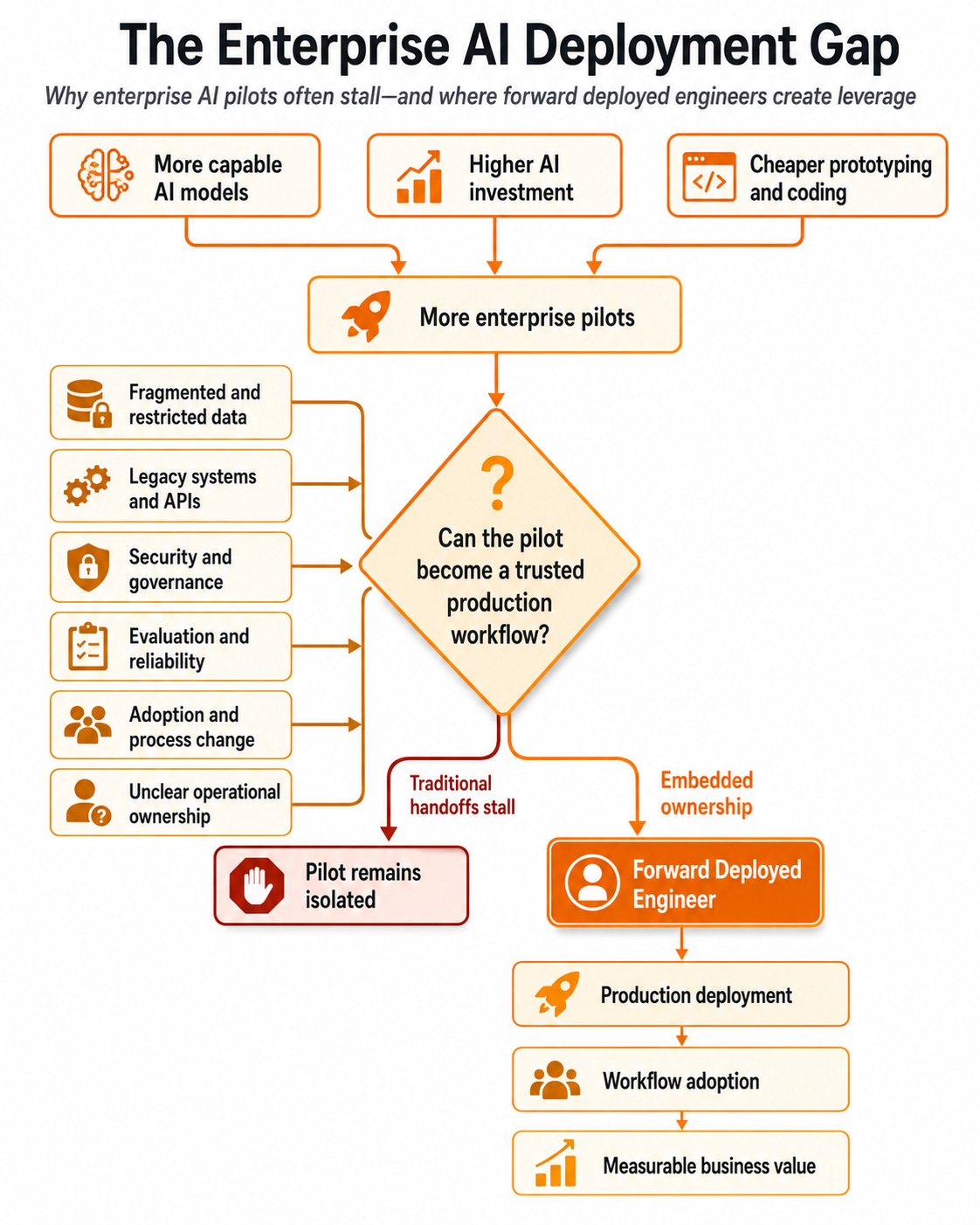
The role is expanding because enterprises have purchased access to powerful AI systems faster than they have developed the ability to deploy them.
McKinsey’s 2025 global survey found that nearly two-thirds of organizations had not yet begun scaling AI across the enterprise, even though 62% were at least experimenting with AI agents.
The gap between experimentation and production is rarely caused by a single missing model capability.
An enterprise AI system may require:
Permission-controlled access to several databases.
Integration with identity and access-management systems.
Connections to existing SaaS and internal applications.
Evaluation against business-specific failure cases.
Logging, tracing and incident response.
Human approval for sensitive actions.
Legal, privacy and regulatory review.
Workflow redesign and employee training.
Clear ownership after the initial launch.
A conventional software-sales process fragments this work among account executives, solutions engineers, consultants, customer-success managers, product teams, security teams and the customer’s own developers.
Each handoff loses context.
The FDE model reduces those handoffs by giving a technically capable individual or pod responsibility for the outcome rather than one stage of the process.
AWS summarizes the shift directly: enterprise customers are increasingly asking for production systems rather than more AI strategies and road maps.
What an FDE actually does
The modern FDE role grew out of Palantir’s model.
Palantir says it pioneered the position by embedding engineers directly with customers. Its current job descriptions define the role as understanding open-ended operational problems, architecting solutions, working with large datasets and iterating alongside technical and nontechnical users.
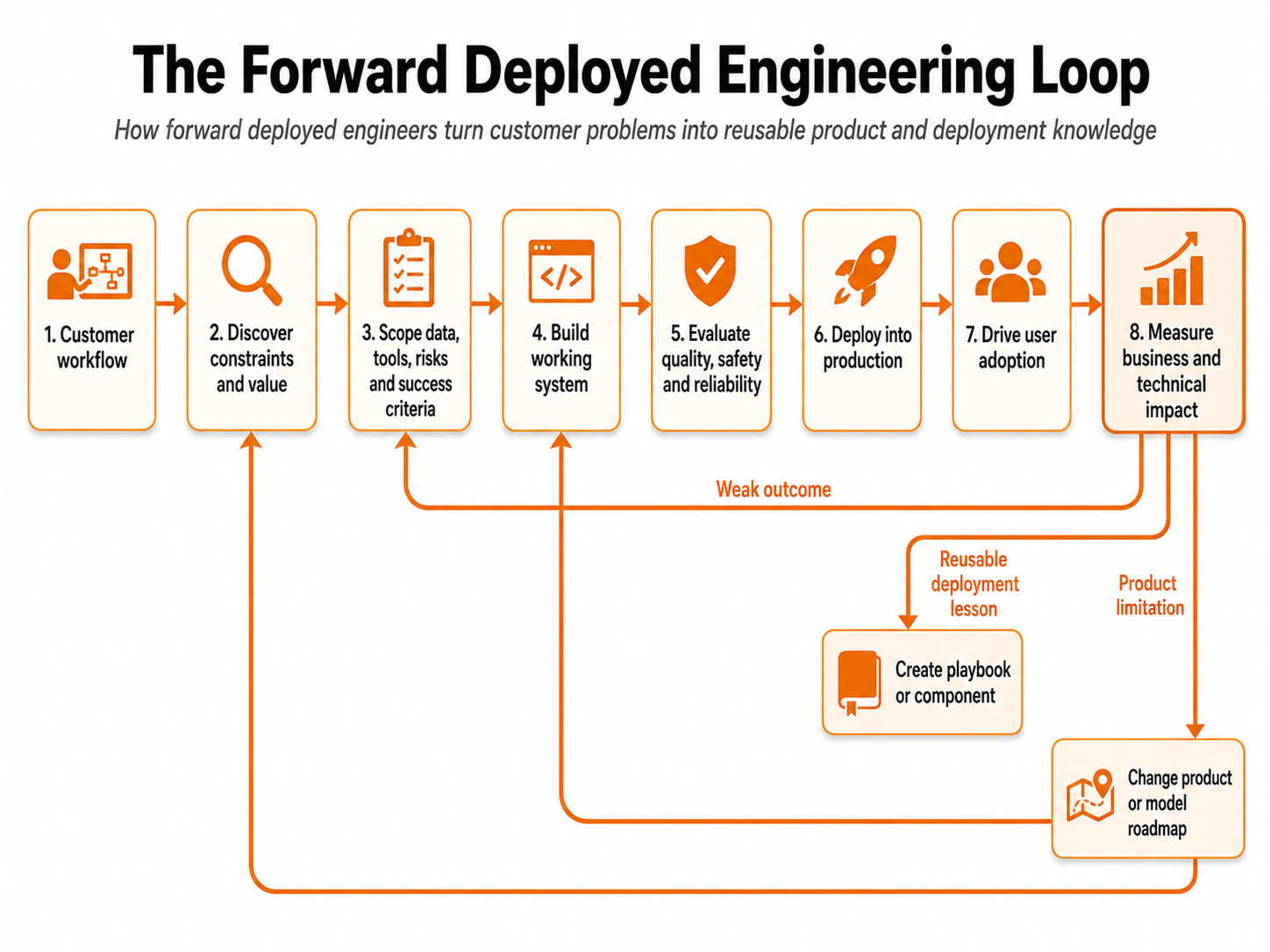
The AI-era version of the job generally contains six stages.
1. Workflow discovery
The FDE identifies a process where AI could produce an operational improvement.
This is deeper than collecting a list of desired features. The engineer must understand how work currently moves through the organization, which decisions matter, where information is lost and what failure would look like.
2. Technical scoping
The FDE translates the workflow into a system design.
That includes the necessary data, integrations, permissions, models, tools, evaluations, user interfaces, human approvals and operational controls.
3. Rapid development
The engineer builds a working version quickly enough to test the assumptions behind the project.
Modern coding agents and model APIs have compressed this phase. A small team can create a convincing prototype in days rather than months.
However, faster prototyping can also produce a larger number of fragile demonstrations. The FDE’s value comes from deciding which prototype deserves to become a real system.
4. Production hardening
The prototype must be turned into a service that can survive actual use.
Authentication, audit logs, retries, rate limits, fallbacks, observability, data isolation, testing and incident procedures become as important as model quality.
5. Adoption and measurement
A technically functioning AI system is not necessarily a successful deployment.
The FDE must determine whether employees use it, whether it changes the target workflow and whether the improvement can be measured against a baseline.
OpenAI’s Technical Deployment Lead role explicitly includes defining value cases, establishing baselines and KPIs, and measuring results before and after deployment.
6. Product feedback and reuse
The engagement should generate something that makes future deployments easier.
That output may be a reusable connector, evaluation suite, reference architecture, security pattern, product feature or implementation playbook.
Without this final step, an FDE organization becomes a collection of expensive custom-development teams.
FDE versus solutions engineering and consulting
An FDE can resemble a solutions engineer or technical consultant, but the expected ownership is different.
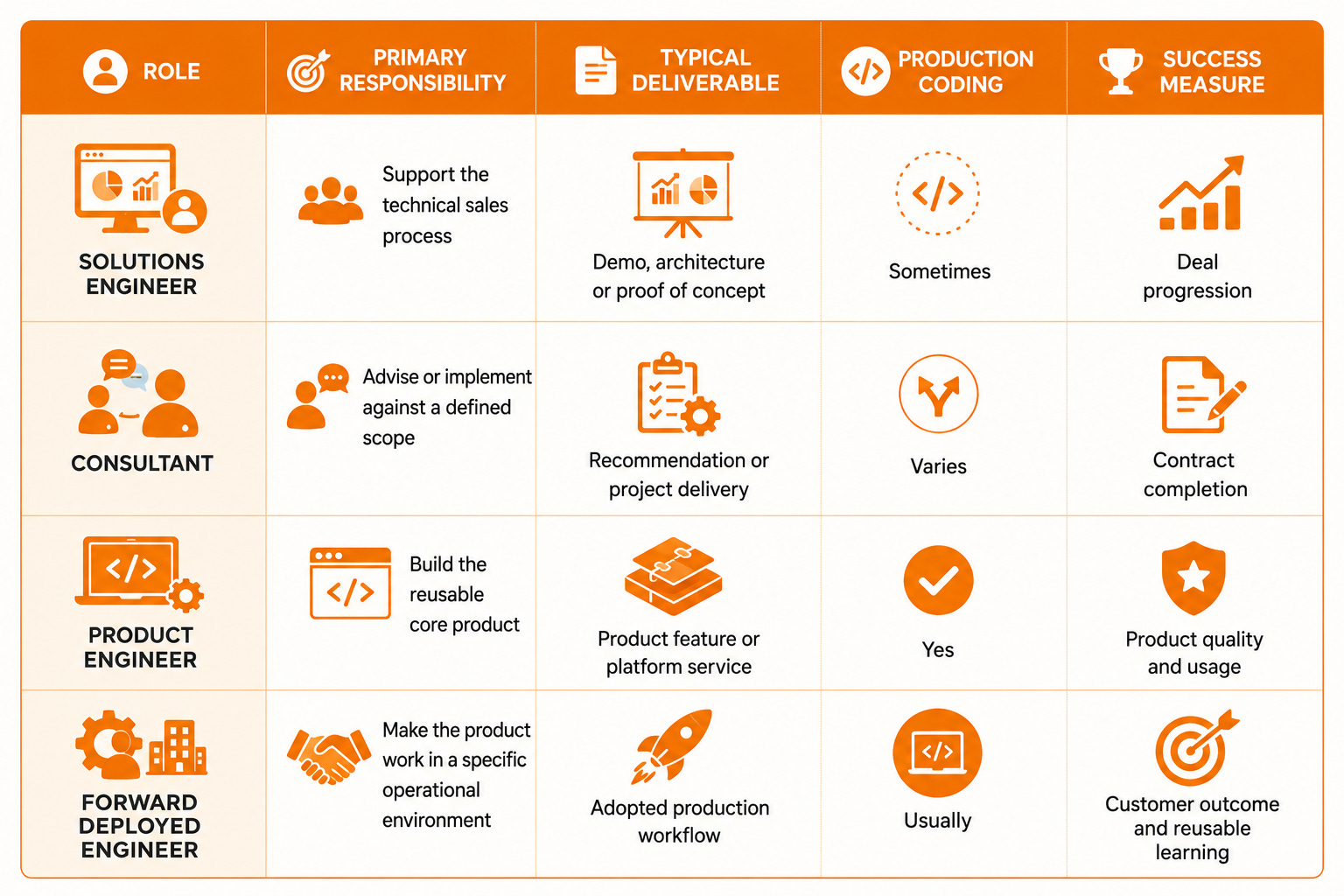
The boundary is not always clean. Some companies may use the FDE title for what is effectively solutions consulting. Others give FDEs significant code ownership and direct access to product and research teams.
Candidates should evaluate the responsibilities rather than the title.
A genuine FDE role should answer several questions clearly:
Who owns production code after launch? How much of the work becomes part of the core product? Is the engineer measured by revenue, delivery, adoption or reliability? How much travel is required? Who responds when the system fails? Can the FDE reject a use case that cannot be deployed safely?
Compensation: lucrative, but not uniformly extraordinary
The report’s compensation headlines reflect the top of the market rather than the entire profession.
Current public job postings provide a more grounded view.
OpenAI lists a base compensation range of $162,000 to $280,000 plus equity for an FDE in New York. Its Forward Deployed Software Engineer role in San Francisco lists $185,000 to $325,000 plus equity.
An OpenAI Technical Deployment Lead position lists $198,000 to $294,000 plus equity.
Anthropic lists $240,000 to $315,000 in annual on-target earnings for an Applied AI Architect role that guides enterprise customers from discovery and evaluation through deployment.
A specialized Palantir FDSE position for autonomous systems lists an estimated salary of $135,000 to $200,000 and travel requirements of 25% to 75%.
These postings confirm that FDEs can be well paid. They do not establish a universal $485,000 median.
The largest packages are likely concentrated among experienced engineers at private frontier-model companies where equity constitutes a substantial portion of total compensation.
Candidates comparing offers should separate:
Guaranteed base salary.
Target and discretionary bonuses.
Liquid public-company equity.
Private equity with regular tender opportunities.
Private equity without predictable liquidity.
Travel expectations and working hours.
Revenue or account-retention incentives.
A high headline package can look less attractive after adjusting private equity for uncertainty, liquidity and vesting.
The skills shortage is real because the role requires opposing strengths
FDE hiring is difficult because the ideal candidate must combine capabilities that technical organizations often separate.
The engineer must move quickly without becoming reckless. They must understand business context without becoming detached from the code. They must communicate with executives while remaining credible with platform, security and data teams.
OpenAI’s FDE posting asks for at least five years of engineering or technical-deployment experience, production-grade frontend and backend development, experience with generative-model systems, and the ability to make decisions under pressure. Travel of up to 50% is required.
A durable FDE skill profile contains four layers.
Software engineering: Python or TypeScript, APIs, databases, testing, distributed systems and full-stack development.
AI engineering: context design, retrieval, tool use, agents, model selection, evaluations and failure analysis.
Enterprise platform engineering: cloud infrastructure, Kubernetes, identity, networking, data governance, observability, secrets and incident response.
Deployment leadership: discovery, technical writing, stakeholder management, prioritization, adoption and business-value measurement.
The best candidates frequently come from startup engineering, solutions architecture, platform engineering, technical consulting, data engineering or technical founder backgrounds.
The economic promise—and the services trap
FDEs can make enterprise software more effective because they move product learning closer to the customer.
A product team may believe it has an integration problem when the real issue is access governance. A customer may request a chatbot when the valuable opportunity is a constrained workflow that automatically gathers information and prepares a recommendation for human approval.
An embedded engineer can discover that difference much faster than a conventional feature-request process.
But the model can become economically dangerous.
Every customer may request unique data pipelines, interfaces, policies and business logic. If those requirements remain custom, revenue growth demands almost proportional growth in engineering headcount.
The company then begins to resemble a professional-services firm while still carrying the research, infrastructure and valuation expectations of a software company.
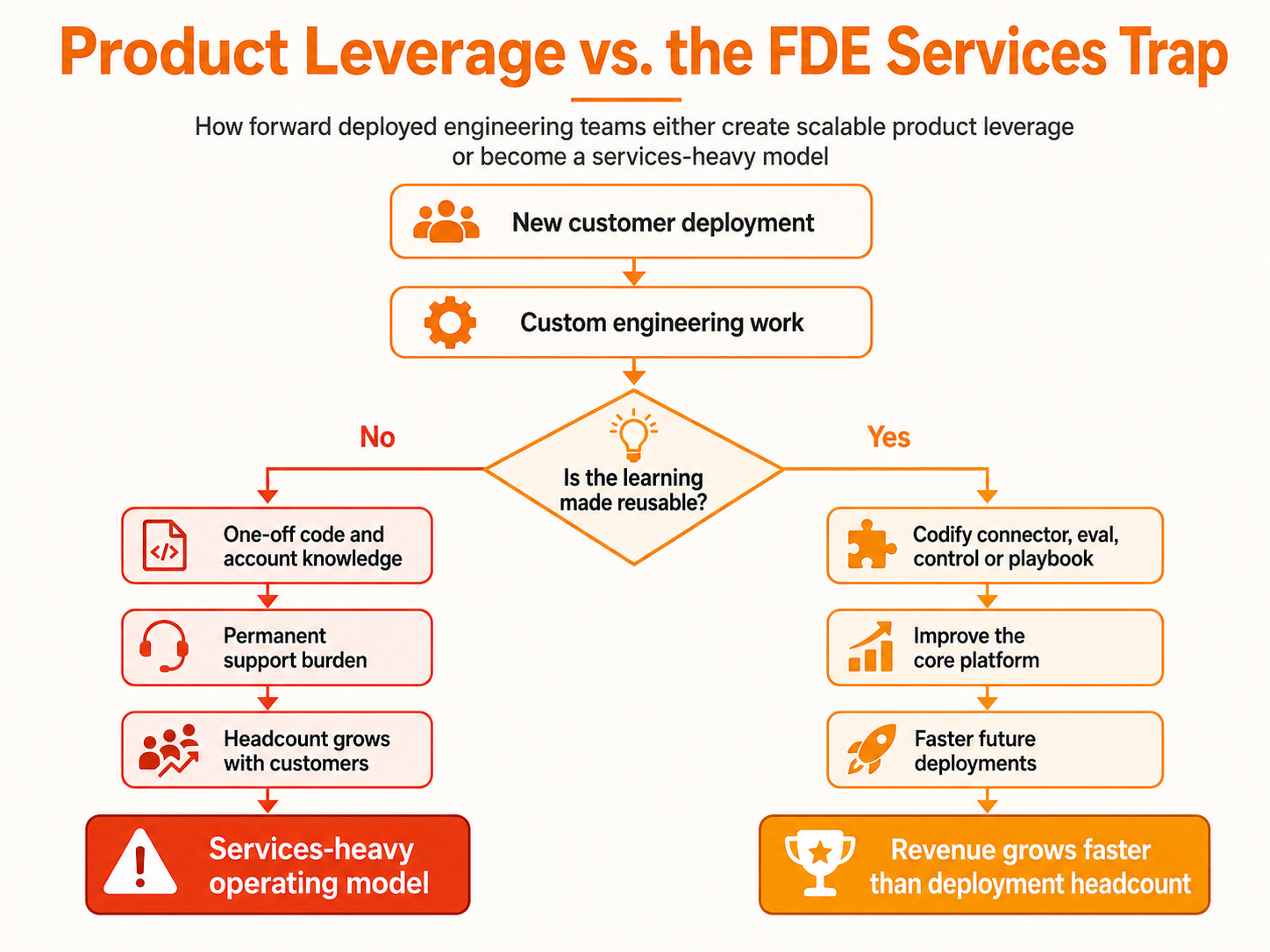
A scalable FDE organization therefore needs explicit reuse targets.
OpenAI says its FDEs should turn successful patterns into tools, playbooks and building blocks. Its Forward Deployed Software Engineers are expected to design abstractions that improve speed and quality across future engagements.
AWS similarly emphasizes reusable delivery infrastructure and customer self-sufficiency rather than permanent dependency.
The operational risks enterprises should not ignore
Embedding external engineers inside sensitive workflows can accelerate delivery, but it increases the importance of access and accountability.
FDEs may need production data, system credentials, internal documentation and direct contact with employees performing regulated work.
The deployment model should therefore define:
Least-privilege access and time-limited credentials.
Separation between development and approval authority.
Data-residency and retention requirements.
Ownership of custom source code and deployment artifacts.
Security review before production access.
Audit logging for human and agent actions.
Incident-response responsibilities.
Maintenance and handover after the FDE leaves.
Speed becomes dangerous when the FDE is allowed to bypass platform standards instead of helping the organization meet them.
The most successful model is not an engineer secretly building around enterprise controls. It is an engineer who brings product, platform, security and operational teams into a faster shared delivery loop.
FDEs may eventually automate part of their own work
The role’s future contains an interesting contradiction.
FDEs are valuable because enterprise deployments currently require substantial human interpretation and custom engineering. Yet one of their core responsibilities is to turn repeated work into reusable systems.
Palantir has already introduced an “AI FDE” capable of performing tasks inside its Foundry platform through conversational commands. The system became generally available in March 2026.
Coding agents will also reduce the time required to create interfaces, connectors, tests and infrastructure configurations.
This is unlikely to eliminate forward deployed engineering soon. It will change what human FDEs spend time doing.
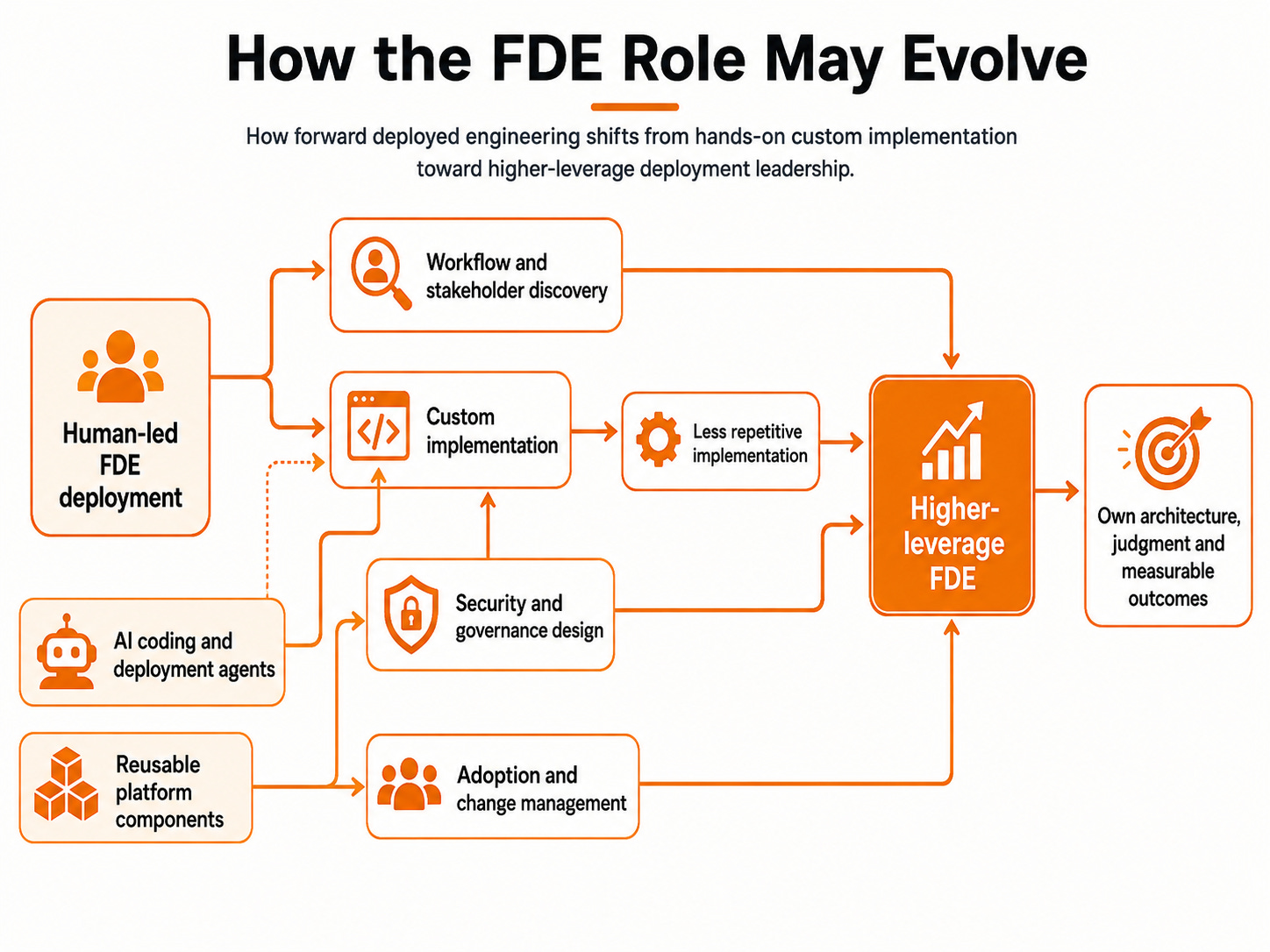
Routine implementation will increasingly move to coding agents and platform automation. Human engineers will spend more time on ambiguous workflow discovery, architecture, risk judgment, organizational negotiation and outcome measurement.
In effect, the role may become less about personally writing every line of customer-specific code and more about directing a deployment system composed of humans, agents and reusable platform components.
What happens next
Forward deployed engineering will probably not remain a single, uniform job title.
The function is already separating into several specialties:
FDEs who own discovery and overall deployment.
Forward deployed software engineers who build reusable customer solutions.
Technical deployment leads who manage complex programs.
Platform FDEs who create common deployment infrastructure.
Security FDEs who work in regulated or classified environments.
Industry FDEs with expertise in healthcare, finance, government or manufacturing.
Partner FDEs working inside systems integrators and consultancies.
This specialization is a sign that forward deployment is becoming an organizational capability rather than a fashionable title.
The report’s prediction that 78% of teams will double in 2027 may prove too aggressive. It is a statement of respondent expectations, not observed hiring.
But the broader direction is difficult to dismiss.
LinkedIn sees exponential role growth. AWS is committing $1 billion and thousands of engineers. OpenAI maintains a large global FDE hiring footprint. Anthropic is expanding Applied AI delivery capacity, and Salesforce is building a partner ecosystem around the model.
Final analysis
The FDE boom is not primarily evidence that enterprises want more customized software.
It is evidence that the current AI product model is incomplete.
Frontier models may provide the underlying intelligence, but production value depends on data, permissions, evaluations, infrastructure, governance, workflow design and human adoption.
Those elements cannot always be packaged into a universal API or solved through a remote implementation guide.
Forward deployed engineers have become valuable because they occupy the space between what AI products can theoretically do and what enterprises can safely operate.
For technology vendors, the strategic test will be whether FDE teams create product leverage or permanent customization debt.
For enterprises, the test will be whether embedded engineers transfer knowledge and operational capability instead of creating another layer of external dependency.
For engineers, the opportunity is significant but demanding. The role rewards people who can build production systems, communicate across organizational boundaries and take responsibility for results rather than merely completing assigned technical tasks.
The reports capture that shift, even if its compensation figures, tooling claims and hiring forecasts should be treated cautiously.
The defining technical job of the enterprise AI era may not be the person who trains the model.
It may be the person who makes the model useful when it meets reality.
Cut code review time—and bugs—in half.

CodeRabbit gives fast-moving engineering teams AI-powered code reviews that catch bugs, suggest fixes, and learn your team’s coding preferences directly inside your workflow.
Trusted by 15,000+ teams and used across 6M repositories, CodeRabbit helps developers ship faster without sacrificing code quality.
2-click install. Available in PRs, CLI, and IDE.
What is the pipeline for training "Junior FDEs" into fully capable FDEs?
Honestly, the reuse question decides whether any of this works. If the fifth deployment in an industry doesn't cost meaningfully less than the first, you've got a consulting shop priced like a software company, and nobody seems to publish that curve.