
When Does Integrating AI Become a Product Feature vs. an Engineering Shortcut?
How to tell if your AI integration is building real product value or just adding future tech debt.

It’s late in the sprint. The backlog is overflowing. Someone on the team says:
“We could just throw an LLM at it — problem solved.”
That sentence has launched both game-changing product features and some of the most expensive, fragile tech debt I’ve ever seen.
The challenge is that AI can be either the foundation of a new product capability or a quick patch to ship something under pressure. Both paths look the same on day one. Six months later, one is a competitive differentiator… and the other is a liability that bleeds time and budget.
Why This Question Matters
Investor hype is pushing teams to “AI-ify” their products.
Engineering constraints make AI seem like an easy fix when the real issue is architectural.
PM pressure for visible user-facing wins leads to premature integrations.
The result? A lot of products that are “AI-powered” in the same way an electric toothbrush is “nuclear-powered” — technically true, but misleading and irrelevant to the user experience.
The Three-Lens Test for AI Integration
As a VP, I run every AI idea through three lenses before approving resources.
Think of it like a triangular filter — if an idea doesn’t pass all three, it’s probably an engineering shortcut, not a feature.
1. User Value Lens
Feature:
Creates new capabilities for the user that couldn’t exist without AI.
Fundamentally changes the product’s core workflows.
Shortcut:
Solves an internal technical constraint, invisible to the user.
Adds “wow” factor but doesn’t change the core user outcome.
Example Graph:
A two-axis chart:
X-axis: “User-perceived value” (low to high)
Y-axis: “AI dependency for function” (low to high)
Top-right quadrant = True AI Feature.
Bottom-left quadrant = Likely Shortcut.
2. Sustainability Lens
Feature:
AI is designed into the architecture from the start.
Has monitoring, retraining, and fallback systems in place.
Cost models are stable and predictable.
Shortcut:
Relies on a single vendor API without redundancy.
Latency, cost, and model drift aren’t accounted for.
Example Diagram:
A lifecycle flow showing:
Idea → Prototype → Integration → Ongoing model ops (monitor, retrain, audit).
Shortcut integrations skip the last step entirely.
3. Strategic Differentiation Lens
Feature:
Uses proprietary data or model fine-tuning unique to your product.
Hard for competitors to copy quickly.
Shortcut:
Could be cloned by anyone with the same API key.
Offers no lasting moat once the novelty wears off.
Example Visual:
A “moat depth” bar graph comparing:
Proprietary AI trained on unique data (deep moat)
Open API integration (shallow moat)
Why Teams Fall Into the Shortcut Trap
Deadline Pressure – Product needs to ship, so the fastest path is taken.
Hype Pressure – Stakeholders demand “AI” on the roadmap slide.
Skill Gap – Team lacks domain knowledge, so they reach for AI instead of solving root causes.
Mismatched Incentives – PMs rewarded for visible user-facing change; engineers rewarded for technical delivery speed.
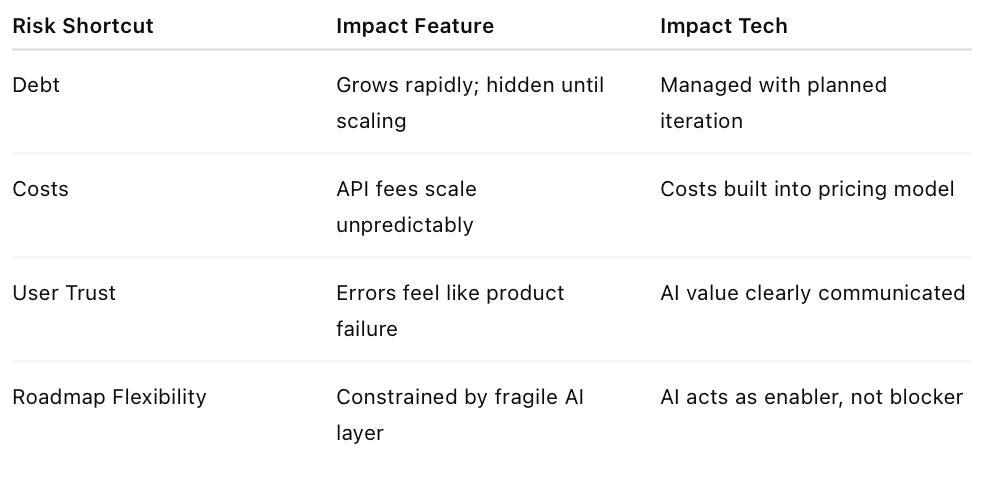
The Cost of Getting It Wrong
A Practical Decision Framework
Before integrating AI, ask:
Could we deliver a meaningful version without AI?
If yes → AI is likely an enhancement, not the core feature.
What happens if the AI breaks or degrades?
Do we have a fallback that maintains user trust?
Will this AI still be relevant in 12 months?
If it’s just novelty, expect fast commoditization.
Can we afford to operate it at scale?
Run a full 12-month cost and latency projection.
Spectrum: Feature vs. Shortcut
Proposed Diagram: A sliding scale with example scenarios:
[ Shortcut ] ---- [ Enhancement ] ---- [ True Feature ]Shortcut:
“AI guesses missing form fields to avoid fixing data model”
Enhancement:
“AI suggests text completions to speed user workflows”
True Feature:
“AI-powered search that understands intent and context”
Takeaway
The difference between an AI feature and an AI shortcut is not about the size of the model or the complexity of the code. It’s about whether AI is the reason the product works, or just a temporary crutch.
The best teams design AI into the heart of their product strategy. The rest wake up one day and realize their “AI-powered” feature is just a dependency they don’t control.
PARTNER WITH US
Tech Scoop lands in the inboxes of 10,000+ tech leaders and engineers — the kind who build, ship, and buy.
No fluff. No noise. Just high-impact visibility in one of tech’s sharpest daily reads.
👉 Interested? Fill out this quick form to start the conversation.