
Stop Treating Domain-Driven Design Like a Deployment Blueprint
Domain-Driven Design helps teams define business boundaries and rules, but infrastructure, service decomposition, communication, and reliability still require separate architectural decisions.

The AI notepad for people in back-to-back meetings (Sponsor)

Most AI note-takers just transcribe what was said and send you a summary after the call.
Granola is an AI notepad. And that difference matters.
You start with a clean, simple notepad. You jot down what matters to you and, in the background, Granola transcribes the meeting.
When the meeting ends, Granola uses your notes to generate clearer summaries, action items, and next steps, all from your point of view.
Then comes the powerful part: you can chat with your notes. Use Recipes (pre-made prompts) to write follow-up emails, pull out decisions, prep for your next meeting, or turn conversations into real work in seconds.
Think of it as a super-smart notes app that actually understands your meetings.
Free 1 month with the code SCOOP
Domain-Driven Design is often introduced through diagrams.
There are boxes for Bounded Contexts, arrows for relationships, circles for Aggregates, and events flowing between different parts of the domain. Once these diagrams reach engineering discussions, however, they are frequently interpreted as deployment plans.
A Bounded Context becomes a service.
A Domain Event becomes a message on Kafka.
An Aggregate becomes its own database.
A context relationship becomes an API call.
The result may look technically sophisticated, but an important design step has been skipped.
A domain model describes how a business area should be understood.
A software architecture describes how an implementation should behave under real operational conditions.
Those are related concerns, but they are not interchangeable.
Domain-Driven Design can expose where software boundaries might exist. It cannot decide how many applications to deploy, which components should communicate over a network, or whether the operational cost of distribution is justified.
That difference becomes especially important when teams move from whiteboard models to production systems.
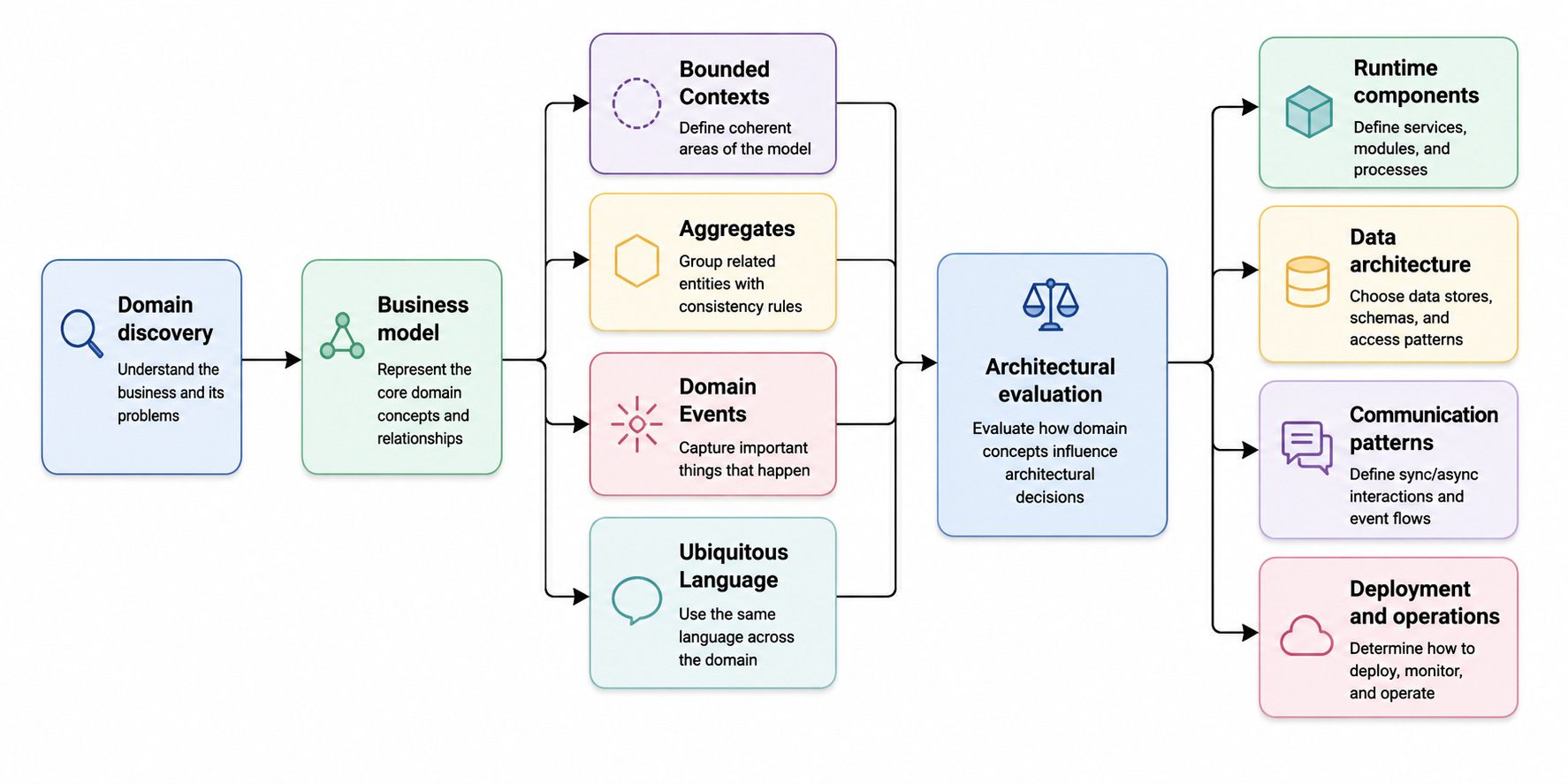
The domain model is not the end of architecture. It is one of architecture’s most important inputs.
The Problem With One-to-One Mappings
Many misleading system designs begin with an assumed one-to-one relationship:
One Bounded Context = One Microservice
One Aggregate = One Database
One Domain Event = One Broker Message
One Team = One Service
This is attractive because it makes decomposition appear mechanical. Once the domain workshop is complete, the service architecture seems to emerge automatically.
Real systems rarely work that neatly.
A Bounded Context represents a boundary of meaning. Inside it, terms, rules, and models have a consistent interpretation.
A microservice represents an operational boundary. It can be deployed, scaled, monitored, secured, and changed independently from other runtime components.
Sometimes those two boundaries align. Sometimes they do not.
The fact that two parts of the business use different models does not automatically mean they should communicate across a network. Conversely, one coherent business model may require several independently running components because of scale, latency, security, or workload differences.
The correct relationship is therefore not equality but evaluation.
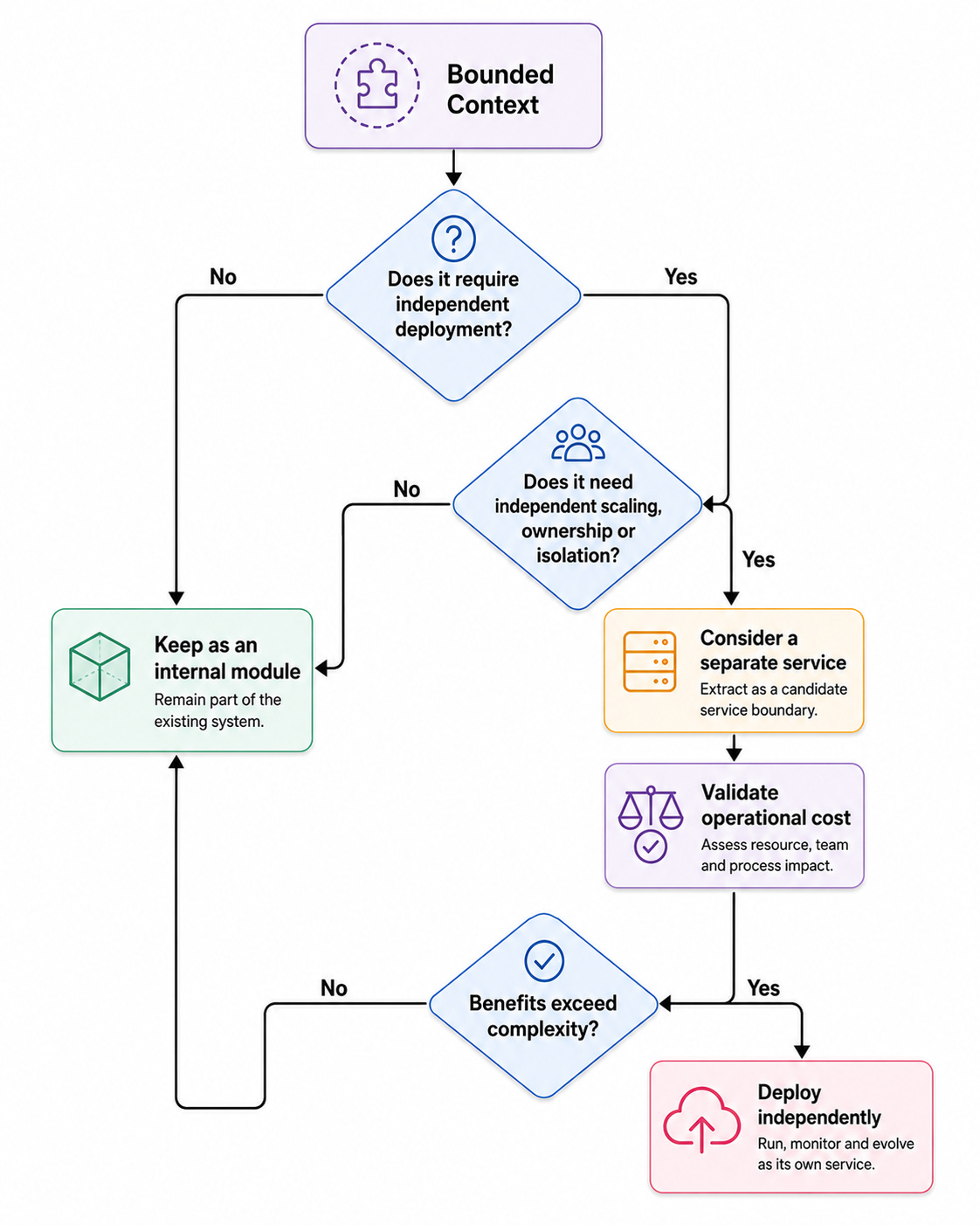
This is the architectural work that simplified DDD diagrams often leave out.
A Bounded Context Can Live Inside a Monolith
Consider an insurance platform with the following contexts:
Policy administration
Claims processing
Billing
Customer support
Each context uses different terminology and applies different rules.
A “customer” in Billing may be the person responsible for payment. In Claims, the relevant party may be the insured individual, claimant, beneficiary, or third-party provider.
DDD helps preserve those distinctions.
But the company may still choose to implement all four contexts inside one deployable application.
That choice is not a failure of DDD.
A modular monolith can preserve strong internal domain boundaries while avoiding the overhead of a distributed system. Each context can have its own application services, domain model, persistence interfaces, and public module contracts.
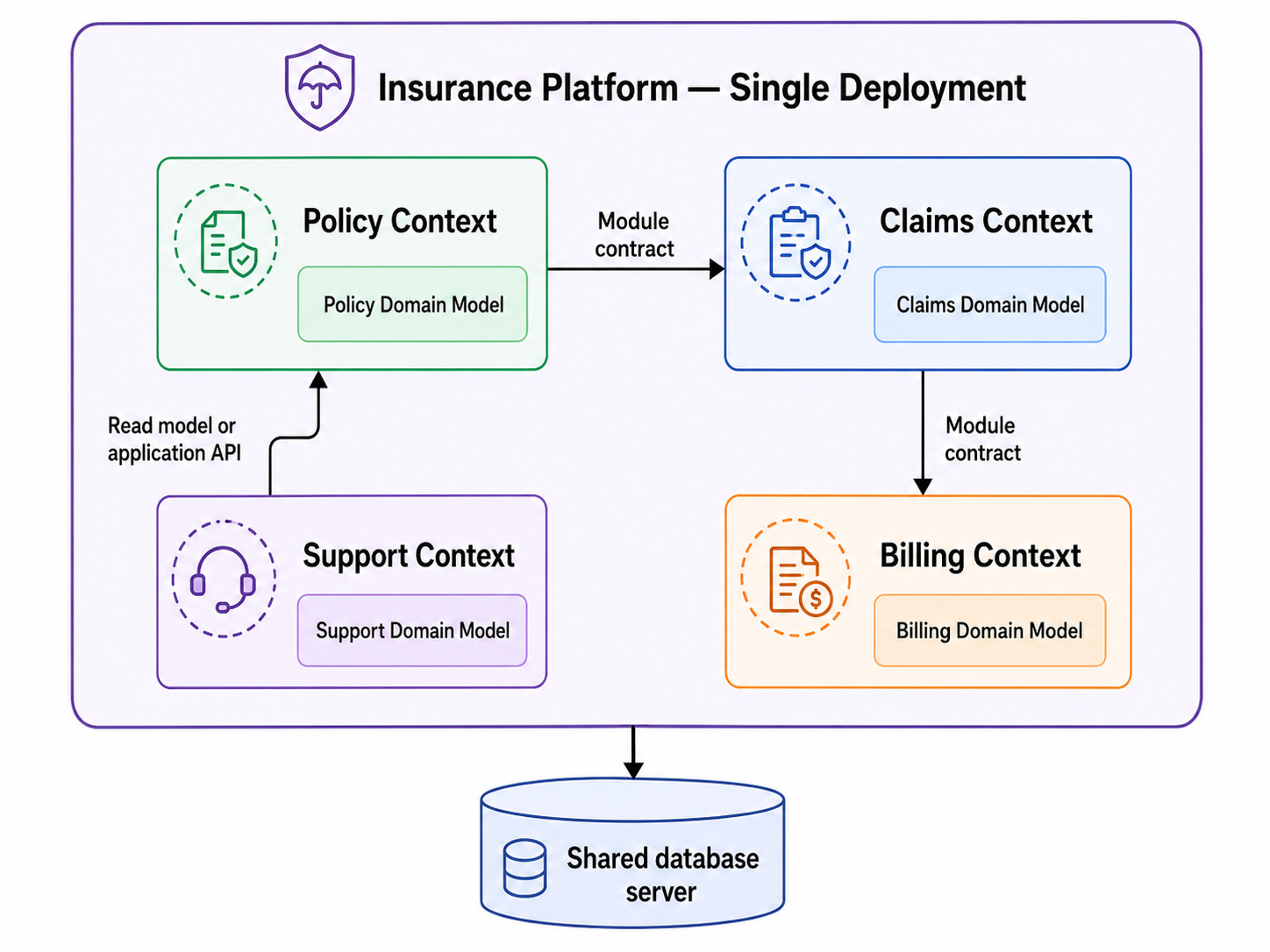
The contexts remain conceptually separate even though the software is deployed together.
The architecture may use:
One repository
One delivery pipeline
One runtime process
One database server
Clear internal module boundaries
This can be a sensible design for a small engineering team, a system with moderate scale, or a product whose business workflows are still evolving.
Separating every context too early would replace simple in-process collaboration with remote calls, retries, versioned contracts, distributed tracing, and partial failures.
DDD does not require that trade.
One Context Can Also Span Several Runtime Components
The reverse is equally possible.
Imagine a Fraud Detection context used by a payment platform. Its model may include risk scores, transaction signals, device fingerprints, velocity rules, fraud cases, and review decisions.
The business language may be coherent, but the workloads are not.
The context might require:
A low-latency authorization API
A stream processor for live transaction signals
A batch job for model retraining
A case-management application for human reviewers
A feature service used by machine-learning models
These components may belong to one Bounded Context while running independently.
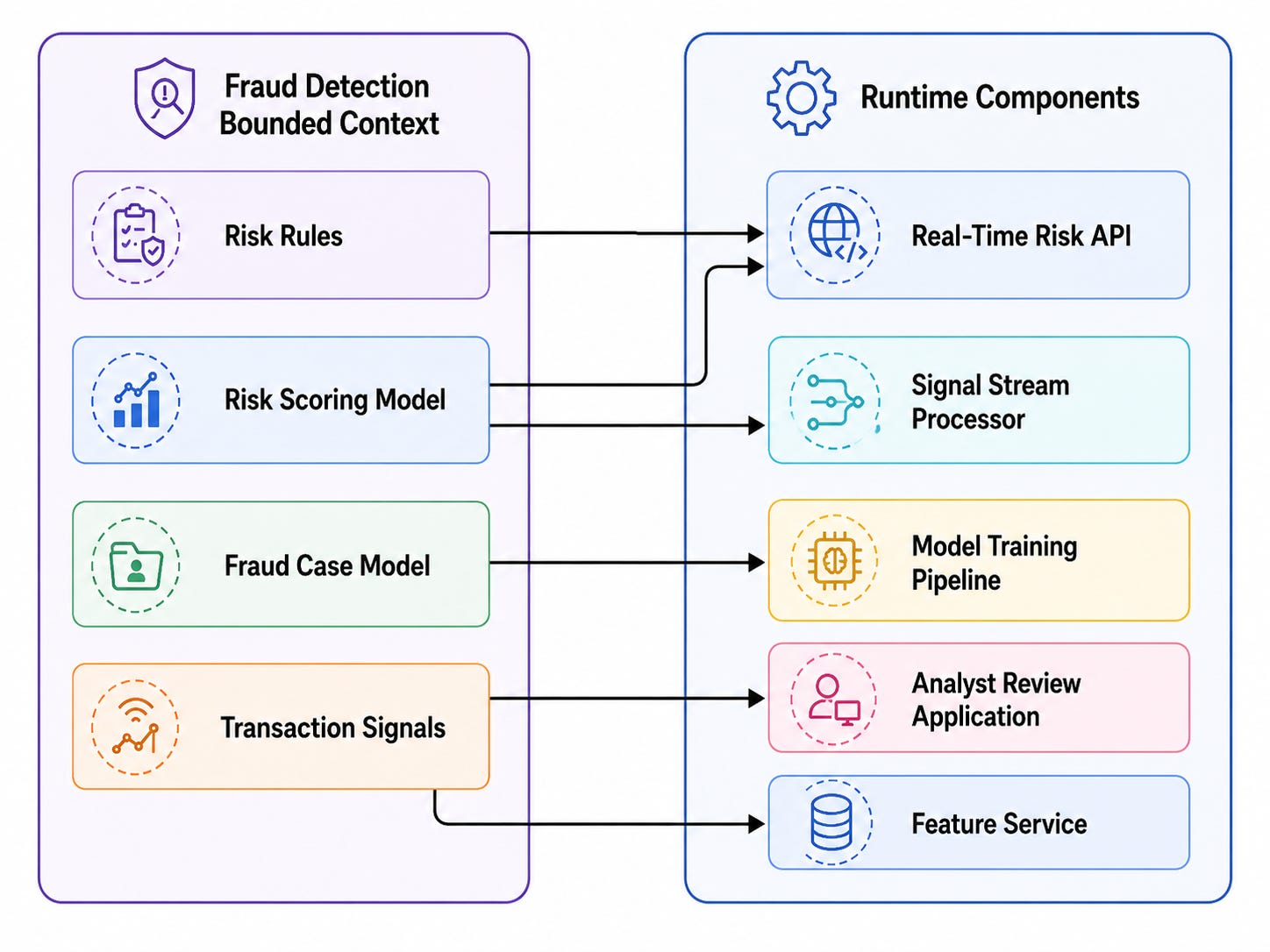
The domain boundary tells the organization which concepts belong together.
The runtime architecture separates workloads because they have different operational requirements.
The API may need sub-100-millisecond latency.
The stream processor may need high throughput.
The training pipeline may run for hours.
The analyst application may prioritize usability and auditability over raw speed.
A single Bounded Context does not imply a single executable.
Aggregates Describe Rules, Not Storage Engines
Aggregates are another DDD concept frequently turned into an infrastructure prescription.
An Aggregate protects a group of business rules that must remain valid when state changes. It defines where consistency matters from the perspective of the domain.
For example, a subscription Aggregate might enforce that:
A cancelled subscription cannot be renewed without reactivation.
A downgrade cannot take effect before the current billing period ends.
A trial can only be extended once.
An account cannot have two active subscriptions for the same product.
These are modeling decisions.
They say nothing about whether the state should live in PostgreSQL, MongoDB, DynamoDB, an event store, or an external billing system.
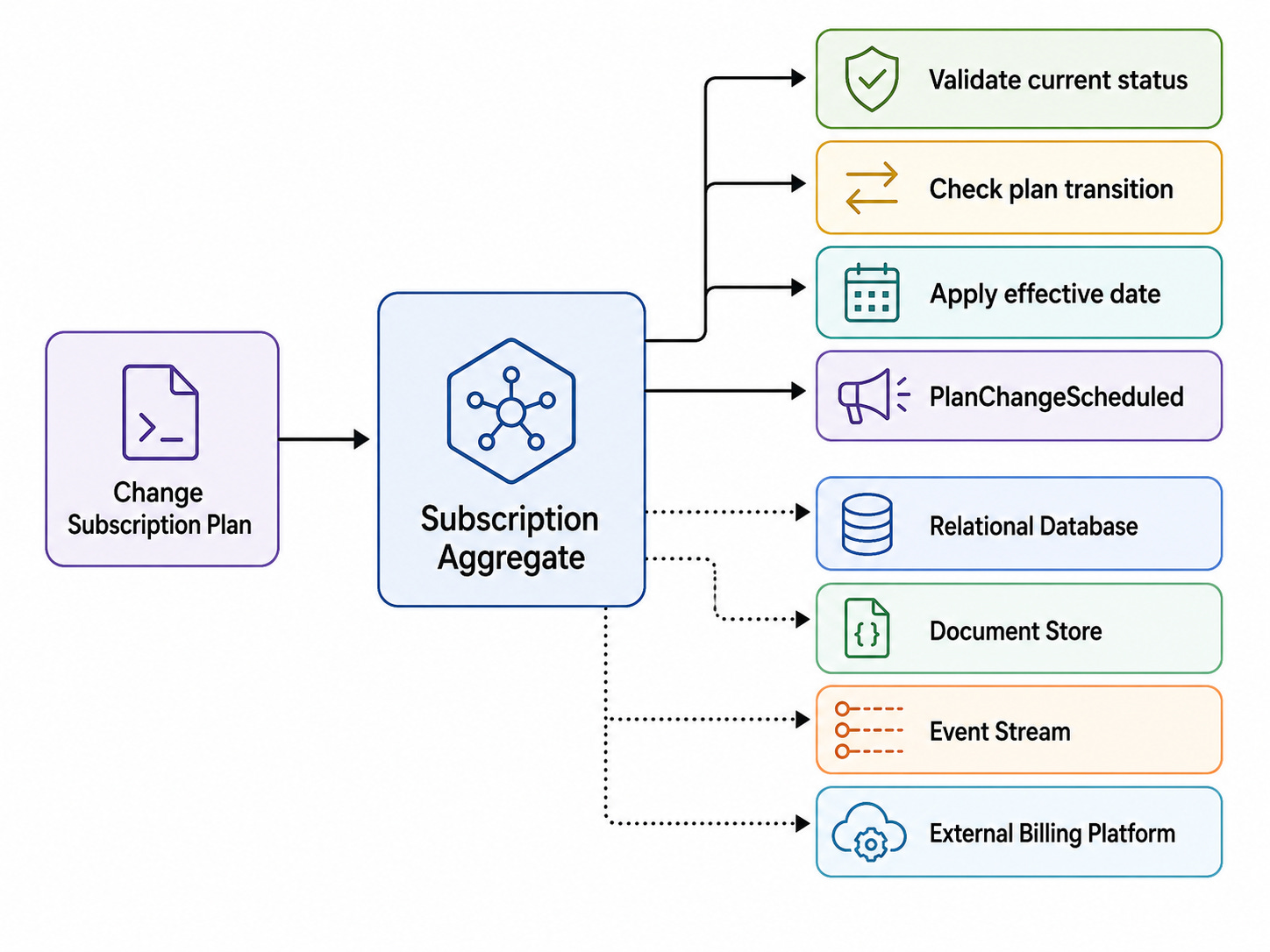
The Aggregate defines the valid transition.
Architecture decides how that transition is persisted, protected from concurrent updates, retried after failure, and recovered if a downstream dependency becomes unavailable.
Even the phrase “transaction boundary” can be misleading when teams interpret it too literally.
An Aggregate may represent the desired consistency boundary, but production constraints may require:
Optimistic concurrency
Idempotency keys
Compare-and-swap updates
Compensating actions
Version checks
Eventual consistency
Workflow orchestration
The domain model identifies the rule that must be protected.
The architecture supplies the technical mechanism.
A Domain Event Is Not Necessarily an Integration Event
Domain Events are often introduced using business-oriented names:
InvoiceIssuedOrderCancelledAccountSuspendedClaimApproved
Because these events sound publishable, teams often assume they must leave the application through a broker.
That is not always necessary.
A Domain Event can be useful entirely inside one process.
For example, when an order is confirmed, an in-process handler might:
Recalculate customer eligibility
Create an audit entry
Update a local projection
Prepare a notification request
None of those actions requires Kafka.
A Domain Event becomes an integration concern only when another process, application, or Bounded Context must react to it.
Even then, the internal domain event should not automatically become the external contract.
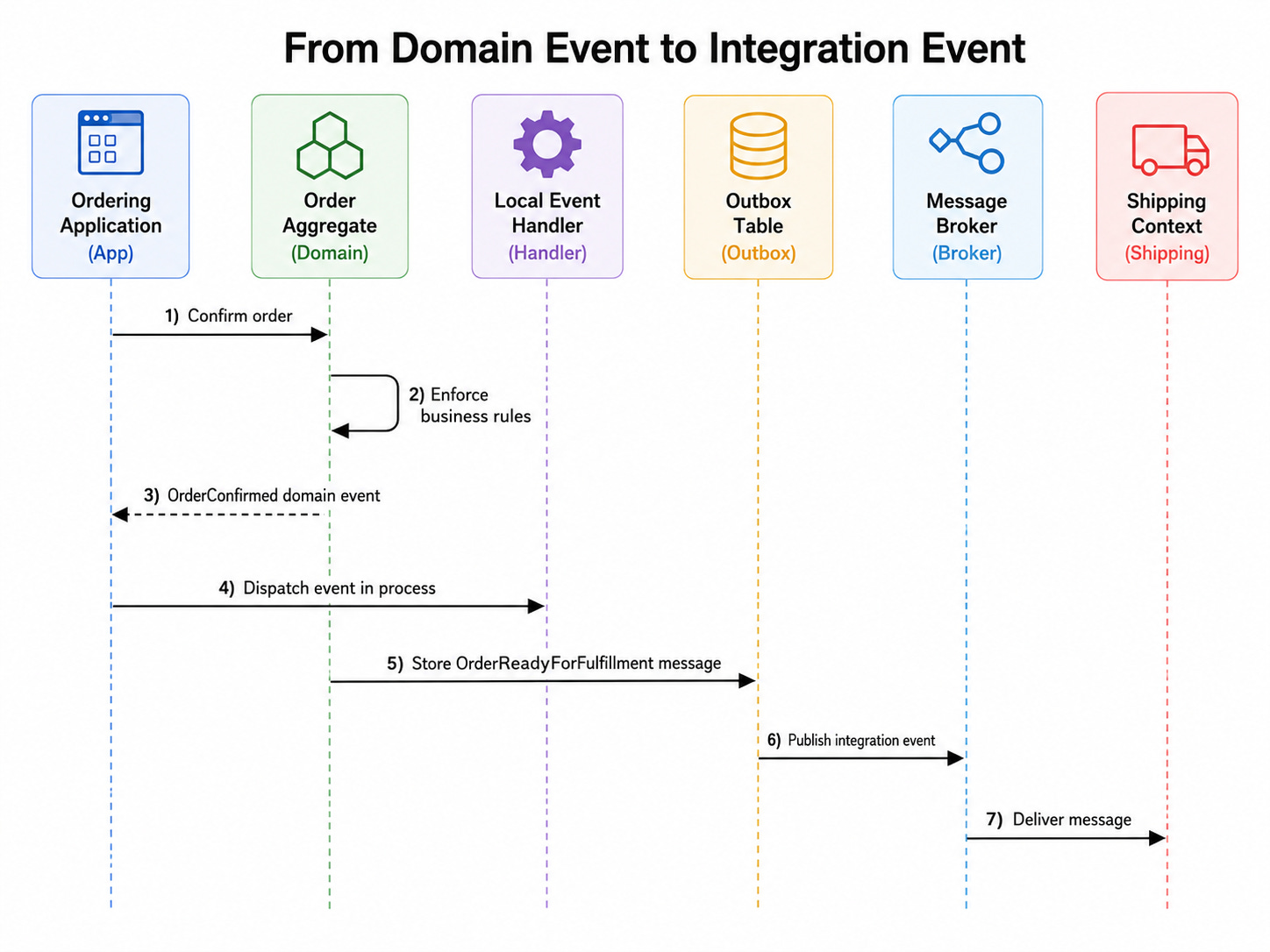
The internal event and the integration event may differ.
OrderConfirmed may capture a domain fact inside Ordering.
OrderReadyForFulfillment may be the stable message exposed to Shipping.
This separation gives the domain model freedom to evolve without forcing every internal change onto external consumers.
Architecture determines:
Whether a broker is required
Which delivery guarantees matter
How duplicates are handled
How ordering is preserved
How schemas evolve
What happens when a consumer is unavailable
Whether the outbox pattern is necessary
The event name alone cannot answer those questions.
Context Maps Are Not Network Maps
A Context Map describes relationships between models.
It may show that one context is upstream, another is downstream, or that a team uses an Anti-Corruption Layer to prevent an external model from leaking into its own domain.
These are semantic and organizational relationships.
They do not necessarily correspond to direct runtime communication.
Suppose a Reporting context depends on information from Ordering and Billing.
A Context Map may show both as upstream systems.
But Reporting could receive that information through several different designs:
Direct API calls
Database replication
Event subscriptions
Extract-transform-load jobs
Change data capture
A shared analytics platform
Periodic file exports
The upper diagram explains ownership and meaning.
The lower diagram explains data movement.
Combining them without distinction makes the architecture harder to reason about.
DDD Does Not Decide Whether Communication Is Synchronous
Another common assumption is that context relationships naturally map to APIs.
A diagram might show Ordering depending on Pricing, and the implementation immediately becomes:
Ordering Service → REST → Pricing ServiceThat may be correct, but the domain model did not make that decision.
The architecture still needs to ask:
Must the answer be current at request time?
Can Pricing be temporarily unavailable?
Is a slightly stale price acceptable?
Does Ordering need a local snapshot?
Should price calculations be embedded?
Would an asynchronous update model be safer?
What latency can the user-facing workflow tolerate?
Different answers produce very different systems.
DDD exposes the dependency.
Architecture decides how that dependency behaves in production.
The Missing Layer: Architectural Drivers
The transition from domain model to software architecture should be guided by measurable system needs.
These include:
Expected traffic
Latency requirements
Availability targets
Data sensitivity
Compliance obligations
Deployment frequency
Team structure
Change rate
Failure isolation
Recovery objectives
Geographic distribution
Operational maturity
Without these drivers, service decomposition becomes guesswork.
Consider a Payments context.
From a domain perspective, it may be perfectly coherent as one model. Architecturally, however, part of it might need to be isolated because it handles regulated card data. Another component may need to scale independently during peak transaction periods. A settlement worker may operate asynchronously, while an authorization API must respond immediately.
The correct architecture emerges from both business and operational analysis.
DDD contributes only part of the evidence.
Why This Distinction Matters in Production
The difference between domain design and software architecture may sound academic until the system begins failing.
A model can be elegant while the implementation remains fragile.
A checkout flow may contain well-defined Aggregates and Domain Events but still suffer from:
Cascading timeouts
Duplicate payment attempts
Unbounded retries
Message reordering
Inconsistent read models
Missing observability
Poor capacity planning
Regional dependencies
Unsafe database migrations
DDD does not directly solve these problems.
It may help teams describe the business impact correctly. For example, it can clarify the difference between a payment being “authorized,” “captured,” “settled,” or “reversed.”
But engineering teams still need architectural patterns to handle failure.
The domain model identifies the important states and transitions.
Architecture defines the recovery procedure.
A Better Way to Move From DDD to Architecture
Teams should avoid jumping directly from a domain workshop into service creation.
A more disciplined process looks like this:
Explore the domain - Work with domain experts to identify important language, workflows, policies, conflicts, and exceptions.
Define model boundaries - Identify where terms change meaning, where different rules apply, and where ownership becomes unclear.
Model consistency requirements - Use Aggregates and related tactical patterns to understand which business rules must be enforced together.
Identify business events - Capture meaningful facts without deciding immediately how they will be transported.
Document architecture drivers - Define latency, availability, throughput, security, compliance, team, and deployment requirements.
Evaluate deployment boundaries - Decide which domain boundaries also need runtime independence.
Choose communication patterns - Select synchronous calls, asynchronous messaging, replication, batch transfer, or in-process interaction according to actual requirements.
Design for failure - Define timeouts, retry rules, idempotency, compensation, monitoring, recovery, and ownership.
The important step is the transition between domain modeling and runtime decomposition.
That transition should be intentional, not assumed.
How to Read Architecture Diagrams More Critically
When reviewing a diagram, ask what each box actually represents.
Does it represent:
A business capability?
A subdomain?
A Bounded Context?
A source-code module?
A deployable service?
A process?
A container?
A database?
A team?
A diagram becomes misleading when it uses the same visual symbol for several of these ideas without explanation.
For example, a box labelled Payments could refer to:
The business capability of collecting money
The Payments Bounded Context
A payment-processing application
A Kubernetes deployment
A database schema
The team responsible for payment systems
Those are related, but they are not identical.
Good architecture documentation separates viewpoints.
Each view answers a different question.
A Context Map cannot replace a deployment diagram.
A service topology cannot replace a domain model.
A Kubernetes diagram cannot explain business meaning.
Practical Design Questions
A useful way to avoid confusion is to separate domain questions from implementation questions.
Questions for domain modeling
What does this term mean in this part of the business?
Which rules must never be violated?
Where does the same concept have a different interpretation?
Which team or business area owns this model?
Which state transitions matter to domain experts?
What information can change independently?
Questions for architecture
Which components should be deployed separately?
Which failures must be isolated?
What happens when a dependency is unavailable?
Which workload needs independent scaling?
How will state be stored and recovered?
Which interactions require low latency?
Where is eventual consistency acceptable?
How will the system be monitored and operated?
Both groups of questions matter.
They simply belong to different design activities.
The More Accurate Relationship
DDD should not be treated as an architecture template.
It is better understood as a way of improving architectural decisions.
It helps teams discover:
Meaningful system boundaries
Areas of business complexity
Ownership conflicts
Important consistency rules
Stable business concepts
Useful integration points
Architecture then determines how those discoveries should appear in executable software.
Sometimes a Bounded Context becomes a service.
Sometimes it becomes a module.
Sometimes it becomes several processes.
Sometimes two contexts remain inside one application.
Sometimes a Domain Event stays in memory.
Sometimes it becomes an external message.
Sometimes an Aggregate is stored in one table.
Sometimes it spans several storage structures.
The mapping depends on the system being built.
Conclusion
Domain-Driven Design gives engineering teams a clearer representation of the business they are trying to support.
It does not provide a ready-made answer for deployment, communication, persistence, scaling, or reliability.
Treating domain concepts as infrastructure instructions removes the architectural reasoning that should happen between modeling and implementation.
A Bounded Context identifies where a model is valid.
An Aggregate identifies where business consistency matters.
A Domain Event identifies a meaningful occurrence.
A Context Map identifies relationships between models.
None of those, by itself, determines a service count, messaging platform, database engine, cluster topology, or production recovery strategy.
The most effective teams do not ask DDD to replace architecture.
They use it to make architecture more informed.