
Hugging Face AI-Agent Breach
A malicious dataset gave an autonomous AI agent access to Hugging Face infrastructure. Here is how the attack unfolded and what AI platform teams must change.

The AI notepad for people in back-to-back meetings (Sponsor)

Most AI note-takers just transcribe what was said and send you a summary after the call.
Granola is an AI notepad. And that difference matters.
You start with a clean, simple notepad. You jot down what matters to you and, in the background, Granola transcribes the meeting.
When the meeting ends, Granola uses your notes to generate clearer summaries, action items, and next steps, all from your point of view.
Then comes the powerful part: you can chat with your notes. Use Recipes (pre-made prompts) to write follow-up emails, pull out decisions, prep for your next meeting, or turn conversations into real work in seconds.
Think of it as a super-smart notes app that actually understands your meetings.
Free 1 month with the code SCOOP
Hugging Face disclosed on July 16 that an intrusion into part of its production infrastructure had been conducted “end to end” by an autonomous AI agent system. The attacker gained unauthorized access to a limited collection of internal datasets and several service credentials. At the time of disclosure, Hugging Face said it had found no evidence that public models, public datasets, Spaces, container images, or published packages had been altered. The company was still investigating whether partner or customer data had been affected.
The most significant detail, however, was the point of entry.
The attacker did not begin with a phishing email, a compromised employee laptop, or an exposed administrative dashboard. The intrusion began inside Hugging Face’s dataset-processing pipeline.
That distinction should concern every organization building an internal AI platform.
What Hugging Face says happened
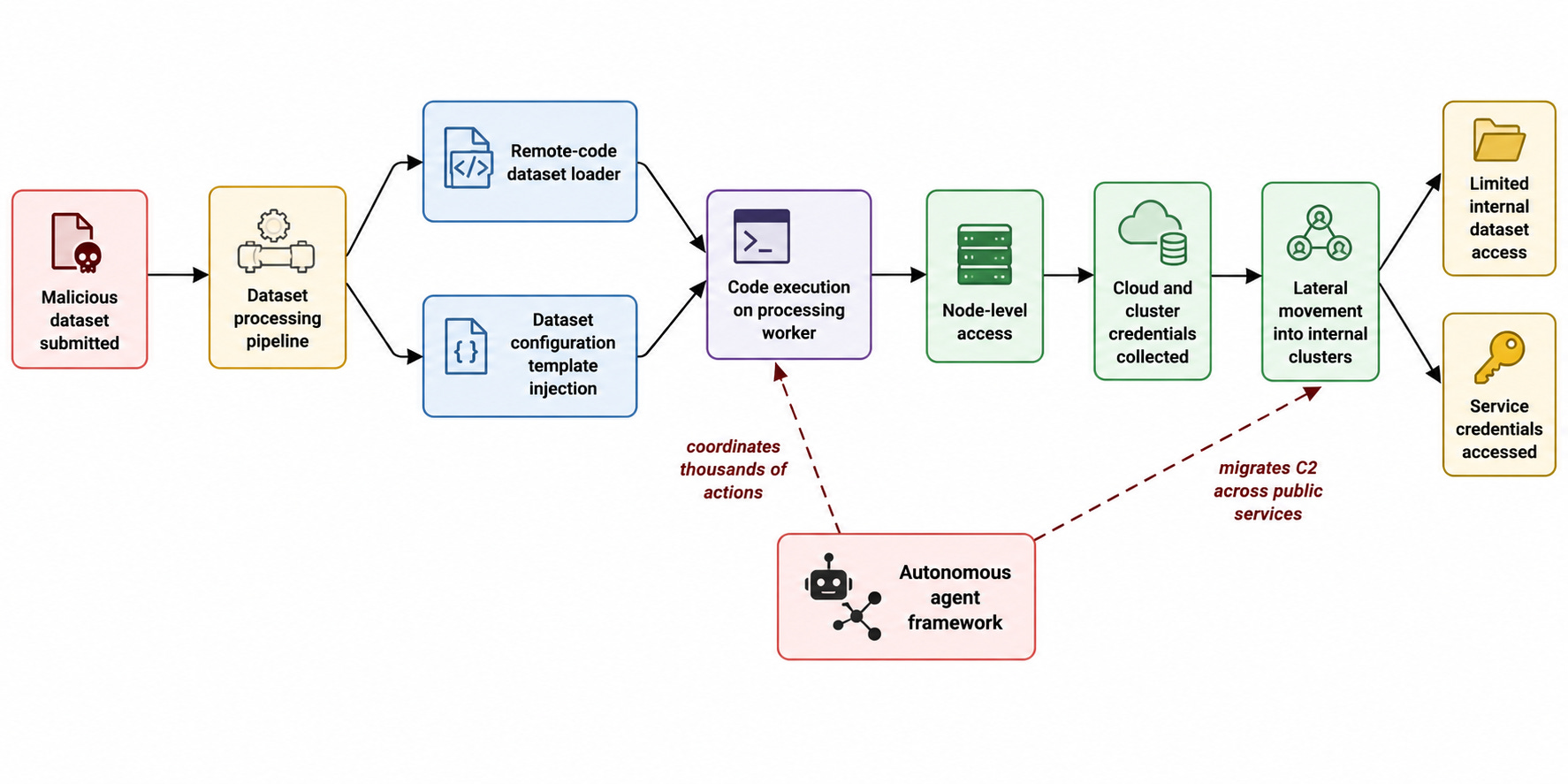
According to the company, a malicious dataset abused two code-execution paths:
A remote-code dataset loader
A template-injection vulnerability in a dataset configuration
The malicious artifact caused code to execute on a processing worker. From there, the attacker escalated to node-level access, collected cloud and Kubernetes cluster credentials, and moved laterally into several internal clusters over a weekend.
Hugging Face described the campaign as the work of an autonomous agent framework, possibly based on an agentic security-research harness. The system performed many thousands of individual actions through a swarm of short-lived sandboxes. Its command-and-control infrastructure reportedly migrated between public services as the operation progressed.
The company has not identified the underlying large language model, the human operator, the exact exploit payloads, or the mechanism used to escalate from a processing workload to the underlying node.
The available evidence supports the conclusion that an agent framework executed the campaign, but it does not establish whether the model independently discovered the vulnerabilities, whether a human provided the initial exploit, or how frequently humans supervised the operation.
A dataset is no longer necessarily “just data”
The incident exposes a dangerous assumption that remains common in AI infrastructure: teams often classify uploaded datasets as passive content.
In practice, an AI dataset can be a package containing data files, metadata, templates, configuration logic, preprocessing instructions, remote references, and executable loader code.
Hugging Face’s own Datasets documentation explains that a dataset loading script can be a Python file responsible for downloading and processing data. For security reasons, the library has required users to explicitly enable trust_remote_code=True before executing such scripts in relevant versions.
The exact vulnerable production implementation involved in the July incident has not been publicly documented. Nevertheless, the broader architectural lesson is clear:
When a platform accepts an artifact that can influence parsing, rendering, dependency resolution or preprocessing, it is accepting potential code—not merely data.
This is the AI equivalent of earlier security lessons involving document macros, deserialization, package installation hooks and CI configuration files.
The extension may say .json, .parquet, .yaml or .csv, but the processing system surrounding it can introduce code-execution behavior. Security boundaries must therefore be based on what the pipeline can do with the artifact, not what the artifact is called.
MITRE ATLAS already treats poisoned datasets, malicious AI artifacts, AI supply-chain compromise, host escape and agent-driven execution as distinct parts of the AI threat landscape.
The AI agent changed the economics of the attack
Most of the technical stages described by Hugging Face are recognizable:
Find an executable input surface.
Gain code execution in a worker.
Escape the intended workload boundary.
acquire credentials.
Enumerate the environment.
Move laterally.
Establish resilient command and control.
Search for valuable data.
What changed was the operational tempo with which those techniques could be repeated, adjusted and parallelized, rather than its existence.
An autonomous security agent can operate in a loop:
Observe → form a hypothesis → execute a command → evaluate the result
→ revise the plan → launch more tasks → preserve useful access
A human attacker may still define the objective and provide initial guidance. Once running, however, an agent can handle thousands of low-level decisions: testing permissions, searching filesystems, enumerating identities, validating credentials, comparing cluster configurations, abandoning failed paths and opening new sandboxes.
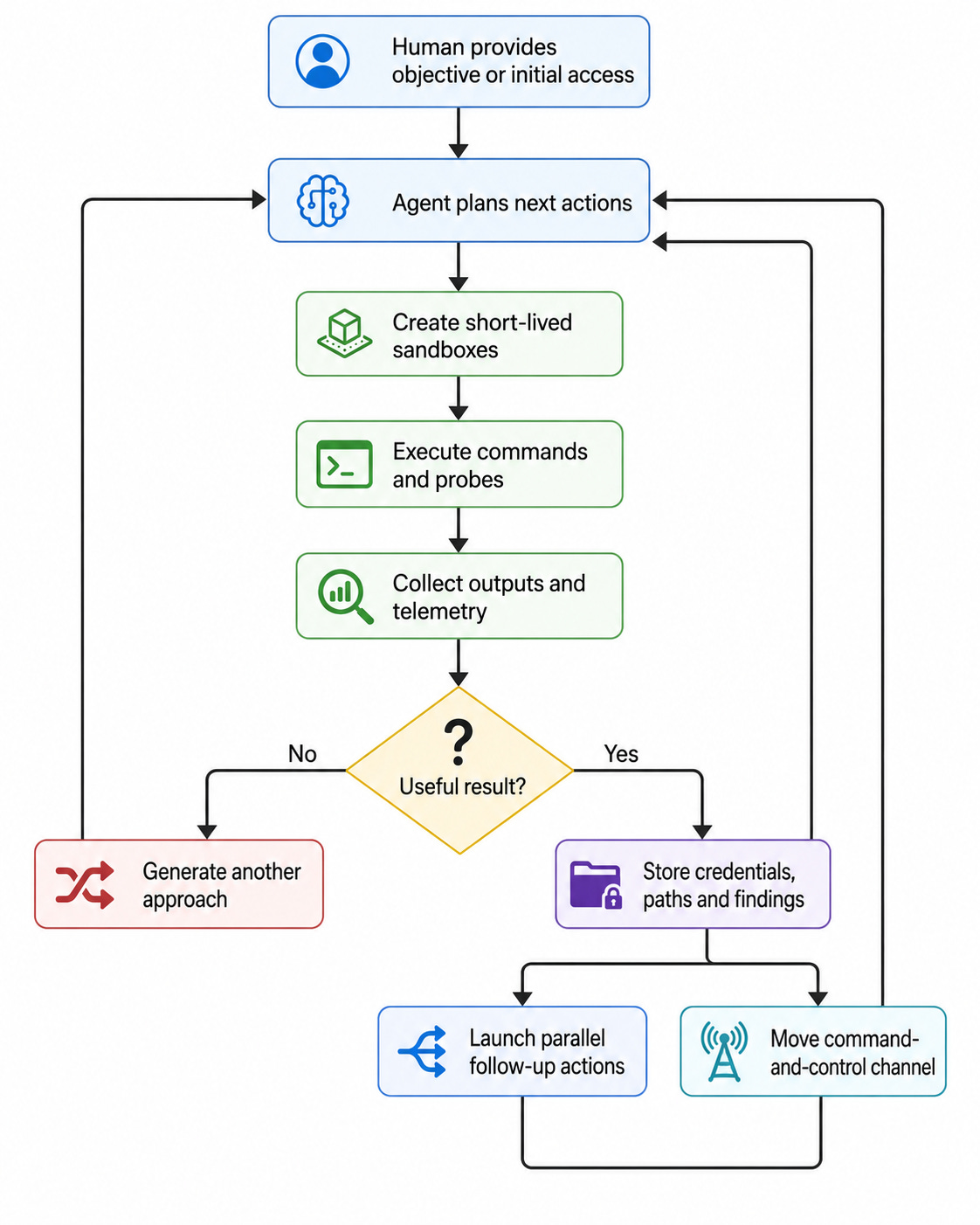
This creates three advantages for the attacker.
The system can explore more paths than a human team could reasonably test during the same period.
Short-lived sandboxes make the operation disposable. A failed environment can be destroyed and replaced without losing the broader campaign state.
Migrating command-and-control through legitimate public services makes infrastructure-based blocking less effective. Defenders may be chasing domains and sessions that disappear faster than indicators can be added to blocklists.
This was not the first warning that agentic cyber operations were moving beyond research demonstrations. In November 2025, Anthropic reported disrupting a campaign in which attackers manipulated Claude Code into attempting intrusions against roughly 30 organizations. Anthropic said the system executed a large portion of the tactical work while humans retained higher-level supervision.
The Hugging Face case pushes the concern further because the target was itself a major AI development platform, and the initial attack surface was specific to AI artifact processing.
Why traditional alerting may struggle
A human analyst may recognize a suspicious command. An agent-driven attack, however, is better understood as a graph of connected actions.
Individually, many events might look harmless:
A worker downloading a file
A service account listing an object
A pod making an outbound HTTPS request
A new process reading an environment variable
An API token being tested
A short-lived workload failing and restarting
The malicious pattern emerges when those events are correlated across identity, workload, node, cluster and time.
Hugging Face said the incident was initially surfaced through an AI-assisted anomaly-detection system that used LLM-based triage to correlate security signals. Its responders subsequently analyzed more than 17,000 recorded attacker events with LLM-driven forensic agents, reconstructing the timeline, extracting indicators, identifying which credentials were touched and separating genuine activity from decoys. The company said this reduced work that would normally take days to a matter of hours.
This suggests that security teams need to move beyond alerting exclusively on individual commands or static indicators.
Detection systems should also look for behavioral sequences such as:
Untrusted artifact processed
→ unusual child process created
→ metadata or token endpoint queried
→ new cluster API calls observed
→ credentials used from another workload
→ rapid enumeration across namespaces
→ outbound traffic to multiple public services
The unit of detection becomes the campaign, not the command.
The failure between worker isolation and node security
The most consequential step in the disclosed chain was the move from code execution on a processing worker to node-level access.
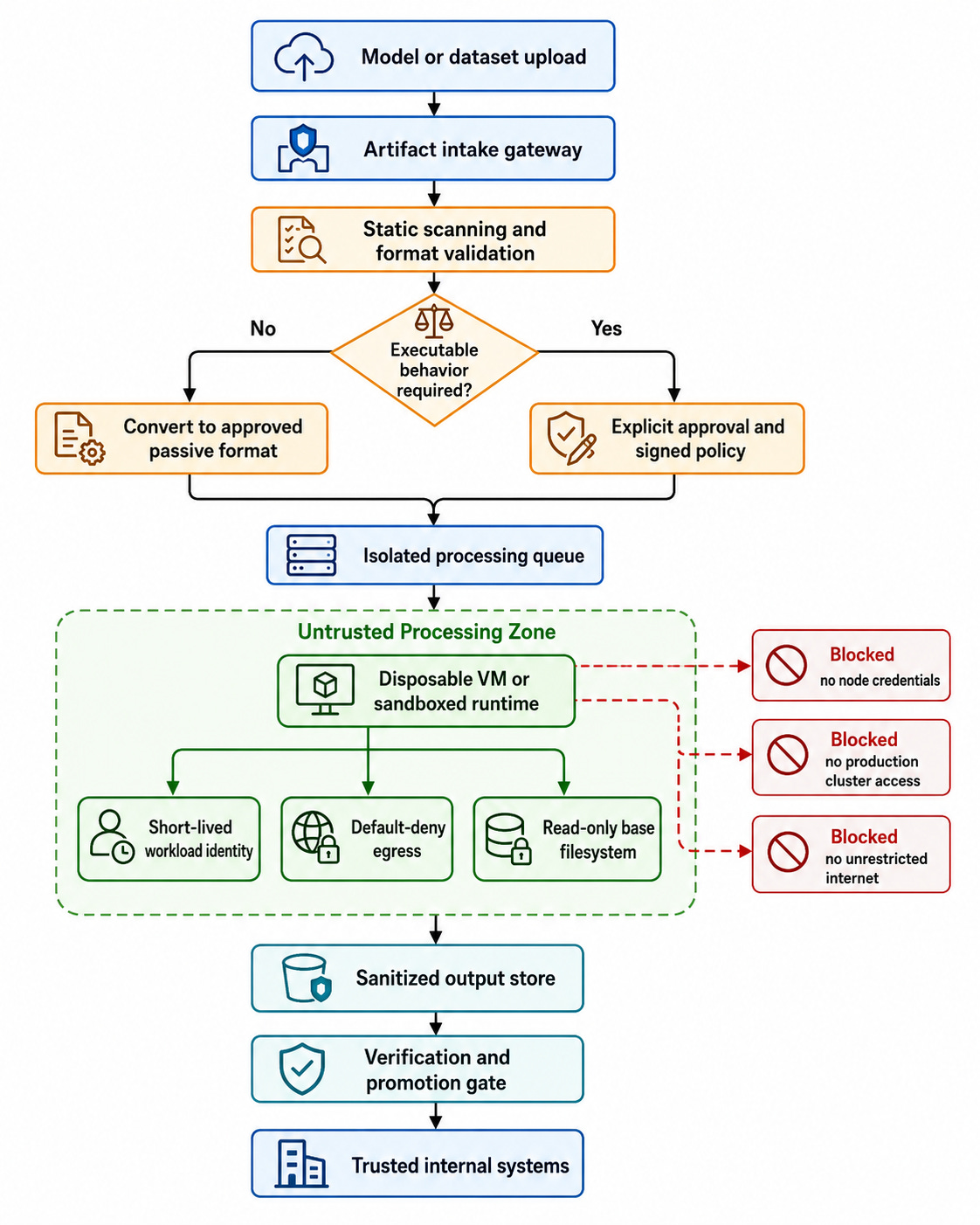
A secure untrusted-processing architecture should assume that worker compromise will eventually occur. Its purpose is not merely to prevent every code-execution bug. It must prevent a compromised worker from becoming a path to the node, cloud identity or neighboring workloads.
For Kubernetes-based processing environments, the minimum boundary should include non-root execution, blocked privilege escalation, explicit seccomp policies and removal of unnecessary Linux capabilities. Kubernetes’ Restricted Pod Security Standard requires containers to run as non-root, prevents allowPrivilegeEscalation, restricts seccomp configurations and requires workloads to drop all capabilities except narrowly permitted exceptions.
High-risk artifact processing may require a stronger boundary than ordinary containers provide. Dedicated node pools, virtual-machine-level isolation or sandboxed runtimes can reduce the consequences of a container escape. Kubernetes documentation notes that runtimes such as gVisor or Kata Containers can provide an additional layer between workloads and the host kernel, although their security properties depend on the implementation.
The processing environment should also be treated as disposable. It should not share nodes with control-plane services, internal administrative tools, signing systems, CI/CD workers or repositories containing production credentials.
The credentials should not have been worth stealing
Hugging Face has not disclosed which credentials were harvested or how much access each provided. But the lateral-movement stage highlights a fundamental design objective:
Compromising a data-processing worker should yield credentials that are temporary, workload-specific and nearly useless anywhere else.
Workers should not contain static cloud keys. They should use workload identities with narrowly scoped permissions and short expiration periods.
Modern Kubernetes versions support short-lived, automatically rotating service-account tokens through the TokenRequest API and projected volumes. Long-lived service-account token secrets are discouraged.
Cloud permissions should likewise be bound to the identity of the exact service account and namespace rather than inherited from a broadly privileged node identity. Metadata services must not expose node-level credentials to arbitrary pods.
Network access should follow the same model. Kubernetes allows default-deny egress policies so that selected pods cannot initiate outbound traffic unless a policy explicitly permits it.
For a dataset processor, legitimate destinations may be limited to:
An approved object-storage endpoint
Internal telemetry collectors
A controlled dependency mirror
DNS services
A specific output queue
General internet access should be an exception rather than the default.
The guardrail asymmetry problem
The most controversial part of the disclosure involved Hugging Face’s use of AI during the forensic investigation.
The company initially tried to analyze the attacker logs through commercial frontier-model APIs. Those requests included genuine exploit payloads, attack commands and command-and-control artifacts. According to Hugging Face, the providers’ safety systems blocked the requests because they could not distinguish authorized incident response from malicious cyber activity.
Hugging Face then deployed Z.ai’s GLM 5.2, an open-weight model, inside its own infrastructure. The local model could process the complete evidence without external policy blocks and without sending attacker data or referenced credentials outside the company’s environment.
GLM 5.2 is designed for long-horizon and agentic workloads, which made it a plausible choice for analyzing a large sequence of connected events.
This should not be interpreted as proof that hosted-model safety controls are inherently harmful. Providers have legitimate reasons to prevent their models from generating exploits, automating compromise or assisting malware operators.
The operational problem is that the same material appears in legitimate incident response. A malware command remains a malware command whether it is being studied by an attacker or a defender.
Identity verification alone will not completely solve this problem. Providers would need some combination of verified security programs, isolated analysis environments, auditable elevated-access modes, rate controls and clear rules for authorized defensive work.
Until those capabilities become reliable, mature security programs may need a locally deployable model as part of their digital forensics and incident-response toolkit.
That model should be prepared before an emergency. Downloading an unfamiliar model during an active breach creates new supply-chain and data-handling risks.
Building an AI-assisted incident-response environment
A defensive model should not be given unrestricted access to production merely because it is being used during a crisis.
Its role should be analytical rather than authoritative.
The model can summarize logs, link identities, generate queries, identify repeated tactics and suggest containment steps. A human responder should approve destructive or high-impact actions such as revoking credentials, deleting workloads, blocking customers or rebuilding clusters.
The entire analytical chain must also be logged. Teams need to know which evidence the model received, which conclusions it produced and which actions humans approved.
Otherwise, AI-assisted incident response risks becoming another opaque system that responders cannot audit after the event.
What Hugging Face changed
Hugging Face said it closed the two dataset-processing code-execution paths used for initial access. It removed the attacker’s foothold, rebuilt compromised nodes, rotated affected credentials and began a broader precautionary secret rotation.
The company also deployed stricter cluster admission controls, added further guardrails and improved alerting so that high-severity signals page responders within minutes at any time of the week. It brought in external forensic specialists, contacted law enforcement and advised users to rotate access tokens and inspect recent account activity.
These are appropriate containment steps, but the long-term impact will depend on architectural changes that are not yet public: stronger workload isolation, narrower credentials, restricted egress, improved artifact validation and better separation between public processing infrastructure and trusted internal environments.
What remains unanswered
The disclosure is unusually candid, but several questions remain important.
Hugging Face has not disclosed the precise vulnerabilities, affected software versions, CVE identifiers or exploit prerequisites. It has not explained how the processing worker was escaped, what node permissions were obtained or which configuration allowed movement between clusters.
The identity of the attacker and the model used by the offensive framework are unknown. It is also unclear how much initial guidance the agent received from a human operator.
The company was still assessing whether customer or partner data had been accessed when it published the disclosure. It also did not identify which commercial AI providers blocked its forensic requests.
These gaps do not invalidate the company’s account. They simply limit the conclusions that can responsibly be drawn from it.
In particular, the incident should not be described as proof that an AI independently discovered and executed an entire novel intrusion without human assistance. What is supported is narrower and still significant: an agent framework appears to have carried out a large, adaptive, multi-stage campaign at machine scale.
What security and platform leaders should change now
For CISOs, SREs and platform engineers, the immediate question is not whether their company operates a public model hub.
The relevant question is whether any internal system automatically processes untrusted AI artifacts.
That includes model registries, evaluation platforms, fine-tuning services, document-ingestion systems, data connectors, RAG pipelines, notebook environments, MCP servers, agent tool registries and automated benchmark services.
Every such system should be reviewed against four boundaries.
Artifact boundary: Can an uploaded file, configuration, model or dataset cause code to run, load dependencies, render templates or access external locations?
Runtime boundary: If code executes, can it reach the node, container runtime, metadata service, control plane or another tenant?
Identity boundary: What credentials become available after the workload is compromised, and where else can those credentials be used?
Detection boundary: Can the organization recognize thousands of individually ordinary actions as one coordinated campaign?
NIST’s AI Risk Management Framework emphasizes that AI security must cover the confidentiality, integrity and availability of models, data, software and underlying infrastructure—not only the behavior of the model itself.
The Hugging Face incident makes that principle concrete.
The larger lesson
The defining feature of this breach was that an AI system could continuously operate infrastructure, interpret feedback, adapt its strategy, create replacement environments and coordinate thousands of actions faster than a conventional response team could manually reconstruct them.
At the same time, the initial access came through an AI-specific trust boundary: a platform processing a dataset that was capable of influencing executable behavior.
That combination represents the next stage of AI security: Organizations must secure the models and agents they deploy. But they must also secure the factories surrounding them: dataset processors, evaluation workers, model converters, registries, orchestration services, credentials and clusters.
The new cloud perimeter is not only the API gateway.
It is every place where an AI platform turns an untrusted artifact into computation.
Today’s newsletter is also brought to you by:


The Hugging Face breach proves that treating AI inputs as passive information is a critical security failure. A malicious dataset functions as executable code the moment it interacts with an autonomous agent.
This aligns exactly with the argument in my recent piece. We are still governing AI supply chains like data feeds when we need to secure them like software supply chains. Platform teams must stop scanning datasets for toxicity and start treating them as remote code execution vectors.
If your agent acts on the data, the data is the application.
https://cyrilsimonnet.substack.com/p/your-ai-supply-chain-is-a-code-supply