
How to Ace Behavioral Interviews in Tech—Strategy, Insights, and Hiring Probabilities

Behavioral interviews have become the cornerstone of tech hiring, with 73% of HR professionals using them as their primary assessment method. For tech job candidates, mastering the behavioral interview is often more critical than many realize, particularly because candidates selected through modern behavioral assessment methods are 14% more likely to succeed in their roles. The path to landing a tech job involves navigating complex hiring funnels where understanding what recruiters and leaders actually evaluate—beyond the STAR method and technical prowess—can be the decisive factor between an offer and rejection.
Understanding the Tech Hiring Funnel and Realistic Probabilities
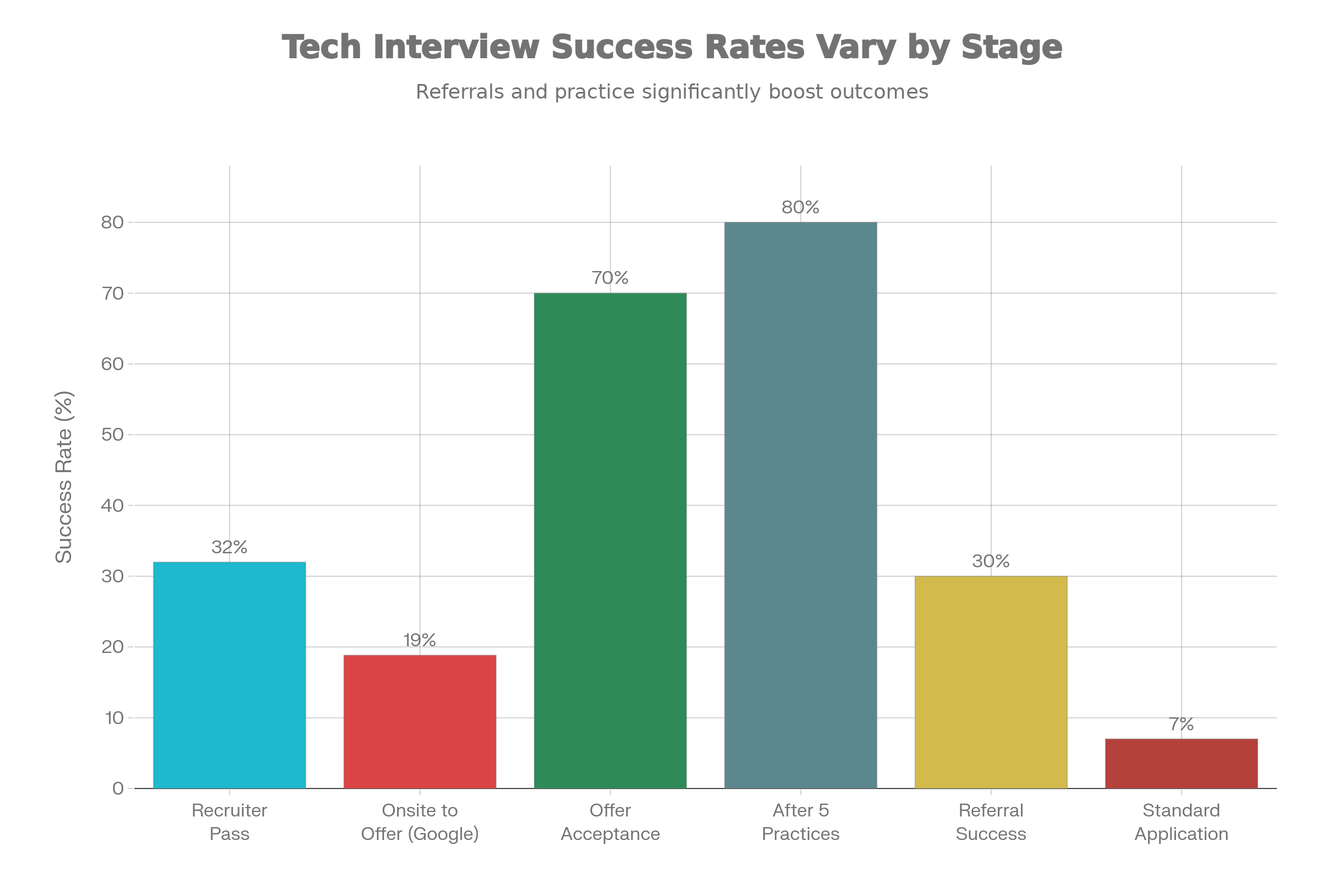
The statistics surrounding tech hiring reveal a brutally competitive landscape. On average, engineers pass only 32% of recruiter screens, but this masks a dramatic divide: the top 25% of candidates pass recruiter screens at a rate of 64.48%, while the bottom 25% pass only 5.54% of the time. This distribution illustrates that your preparation and presentation matter enormously.
For those who advance to the onsite interview stage, the acceptance rates vary significantly by company prestige. At companies like Google, approximately 18.83% of onsite candidates receive offers, though Glassdoor data shows this may be slightly higher than reality due to reporting biases. More conservative estimates suggest the true onsite-to-offer ratio at top-tier tech companies ranges between 10-20%. For perspective, it takes an average of 20 interviews to secure one offer, though if you’re highly selective about companies, you may need 35 interviews—nearly double—to receive your first offer.
However, the most critical number for your success is this: after participating in five practice or mock interviews, candidates’ pass rates jump to approximately 80%. This single data point provides actionable hope—your preparation directly correlates with your outcomes. Additionally, referrals dramatically change the playing field: referred candidates are hired at a 30% rate compared to 7% for all other application methods combined. This 4x advantage underscores why networking and internal connections matter far more than application volume.
For offer acceptance rates, once you receive an offer at a prestigious tech company, you have approximately a 70% chance of accepting it, but this figure is highly correlated with the interview experience—if your experience was positive, acceptance rates climb to 87.5%, while negative experiences drop acceptance to just 33.8%.
The STAR Method
The STAR (Situation, Task, Action, Result) method remains the gold standard framework for behavioral interview responses. However, recruiters note that many candidates use it mechanically, producing rehearsed, disconnected narratives. The key is that your time allocation matters: dedicate approximately 20% to situation, 10% to task, 60% to action, and 10% to result. The action segment is where you prove your value—this is where you should emphasize what you personally did, with specific details and quantifiable metrics.
Beyond STAR, forward-thinking interviewers are adopting the SOAR method (Situation, Obstacle, Action, Result), which adds explicit acknowledgment of challenges, reflecting the reality that candidates who merely highlight successes without addressing obstacles seem unrealistic. The transition to SOAR recognizes that 82% of employers now use virtual interviews, many incorporating AI analysis, and responses must be optimized for both human and machine evaluation.
What Tech Leaders and Recruiters Actually Evaluate
According to a recruiting leader at Zapier, candidates make a critical mistake by providing generic, non-specific responses. She emphasizes that “having those examples ready to go and rehearsed can help a ton,” but crucially, interviewers can detect when answers aren’t authentic.
Meanwhile, a Careem talent acquisition manager states that “behavioral interviews carry a lot of weightage in our hiring process. They help us gain insight into how candidates approach challenges and work collaboratively with others”.
The soft skills imperative has reached new prominence: 92% of recruiters prioritize soft skills over technical skills, citing communication, emotional intelligence, and collaboration as most crucial. This represents a fundamental shift in hiring priorities. Tech companies increasingly recognize that 88% of hiring managers prioritize cultural fit over specific skill sets when choosing between top candidates. While technical capability remains table-stakes, your ability to communicate, learn, and integrate with team dynamics often determines the final hiring decision.
The most revealing insight from business leaders: attitude is non-negotiable and often non-teachable, making it one of the most important hiring factors. Recruiters universally note that you can teach technical skills, but you cannot teach integrity, work ethic, passion, and adaptability.
Critical Success Factors
1. Concrete, Specific Examples with Quantifiable Results
One of the most common rejection triggers is providing vague, generalized responses. Instead of saying “I managed a crisis,” say: “When our API experienced a 99.2% failure during peak hours affecting 47,000 concurrent users, I led a cross-functional response that identified a memory leak in the request handler, deployed a patch within 23 minutes, and restored service to 99.99% uptime while preventing an estimated $340,000 revenue impact”.
Recruiters specifically look for the “power of three”—three concrete action steps you took to achieve results—rather than vague principles. Studies show that patterns of behavior across multiple examples are far more revealing than single isolated successes.
2. Demonstrating Ownership Over Blame-Shifting
Tech company interviewer feedback consistently highlights a critical red flag: candidates who avoid personal responsibility in team failures. When discussing challenges, use “I” language strategically—not to monopolize credit, but to show what you specifically did. Avoid phrases like “the team failed” or “management didn’t understand”; instead, frame it as “here’s what I contributed to the outcome” and “here’s what I learned about my own approach”.
Amazon’s leadership principle of “Ownership” explicitly demands this mindset—employees must think long-term and act on behalf of the entire company, never deferring responsibility with “that’s not my job”.
3. Communication That Bridges Technical and Non-Technical Worlds
Interviewers consistently emphasize that explaining your thought process is as important as your answer. When discussing technical achievements, candidates who can’t articulate their reasoning to non-technical stakeholders create doubt about whether they truly understand their work. Tech companies increasingly probe for “experience explaining technical concepts to non-technical stakeholders”—a skill that predicts team collaboration and leadership potential.
The ability to be concise while specific separates exceptional candidates from adequate ones. Aim for 60-90 second responses to behavioral questions, not 3-minute monologues.
4. Asking Thoughtful, Researched Questions
Not asking any questions when given the opportunity is a significant red flag signaling disengagement. However, asking generic questions about compensation or vacation policy—while valid—doesn’t distinguish you. Instead, ask questions that show you’ve researched the company and thought deeply about the role: “I noticed the team recently launched the new recommendation engine. How is that impacting your user engagement metrics?” or “What are the biggest technical challenges the team anticipates in the next 18 months?”
Genuine enthusiasm for specific aspects of the role is remarkably difficult to fake, and recruiters recognize it instantly.
5. Handling Failures and Setbacks With Growth Mindset
When asked about failures or challenges, the quality of your response determines whether interviewers see growth or stagnation. The strongest responses demonstrate that you: identified what went wrong, took responsibility for your role, extracted specific lessons, and modified your approach in subsequent situations.
Conversely, inability to discuss past mistakes suggests either limited self-awareness or an unwillingness to acknowledge errors—both are significant warning signs. Candidates who become defensive when receiving feedback are flagged immediately as poor cultural fits.
Amazon’s 16 Leadership Principles: A Case Study in Behavioral Evaluation
Amazon has codified the behavioral interview framework through its famous 16 Leadership Principles, which serve as the foundation for essentially every Amazon interview regardless of role. Understanding these principles—not just for Amazon interviews, but as exemplars of what all major tech companies seek—reveals what elite recruiters prioritize:
Customer Obsession: Always start with the customer’s needs and work backwards
Ownership: Act like an owner of the company, not just your job
Invent and Simplify: Encourage innovation and simplify complexity
Learn and Be Curious: Never stop learning and be eager to explore new possibilities
Hire and Develop the Best: Raise the bar with every hire and help people grow
Insist on the Highest Standards: Maintain high quality in everything you do
Think Big: Don’t be limited by small thinking
Bias for Action: Value speed and decisive action
Earn Trust: Listen attentively, speak candidly, and act with integrity
Have Backbone; Disagree and Commit: Respectfully challenge decisions, but commit wholly once made
Each principle maps directly to behavioral questions, and interviewers assess whether your past behaviors align with these values. For instance, when asked about a difficult decision, Amazon interviewers evaluate whether you demonstrate “Have Backbone; Disagree and Commit”—the ability to respectfully dissent while ultimately supporting the team’s direction.
Devastating Interview Mistakes That Trigger Automatic Rejection
Recruiters have identified patterns of mistakes that almost universally lead to rejection:
Vague, Generic Responses to Behavioral Questions
Saying “I always try to stay calm and solve problems” provides zero insight into your actual decision-making process or competence. This signals either lack of real experience or poor interview preparation.
Speaking Negatively About Past Employers or Colleagues
This is particularly devastating because it raises questions about how you’ll discuss them to future employers. It suggests lack of professionalism and inability to navigate workplace dynamics maturely.
Overconfidence Crossing Into Arrogance
Dismissing other strategies as “basic” or acting like you have nothing to learn creates an image of inflexibility and poor collaboration potential. Tech teams, particularly at innovation-focused companies, require intellectual humility.
Giving Fake Weaknesses
Candidates who claim weaknesses like “I care too much” or “I’m too detail-oriented” signal they haven’t genuinely reflected on their limitations. Interviewers immediately recognize this as rehearsed and inauthentic.
Hedging Answers on Sensitive Questions
In 2025, behavioral interviews increasingly probe DEI, remote work philosophies, sustainability, and ethical considerations. Candidates who sense a question might be “tricky” and provide vague, waffling answers lose credibility.
Not Treating the Interview as Two-Way Dialogue
Candidates who merely answer questions without asking any or seeming engaged create the impression they’re simply enduring the process. Top tech talent approaches interviews as mutual evaluation, not interrogation.
Stopping Mid-Answer to Restart Over Minor Mistakes
Self-conscious corrections mid-response (”Wait, let me restart that”) communicate nervousness and undermine confidence. Slight mistakes don’t matter; composure does.
Behavioral Interview Preparation Strategy
Curate 5-7 Core Stories
Rather than preparing for every possible question, develop 3-5 adaptable stories using the STAR/SOAR framework that showcase different competencies. These stories should be flexible enough to answer various questions—a story about “leadership” can often address questions about initiative, problem-solving, or standing up for your values.
Focus 20-30% of Total Interview Prep on Behavioral Rounds
Most candidates disproportionately prepare for coding or technical rounds. Allocate meaningful time to practicing behavioral responses aloud, not just mentally or in writing. Use mock interview platforms or practice with friends to refine delivery, pacing, and authenticity.
Research Company Values and Tailor Stories
Don’t recite generic stories to every company. When you know Amazon values “Bias for Action,” craft a story about a decision you made quickly despite incomplete information and the impact. When you know Google values “Learning and Adaptability,” emphasize stories about navigating unfamiliar technology or pivoting approaches.
Practice With High-Quality Feedback
After five mock interviews, your pass rate typically doubles. Ensure these aren’t perfunctory—seek feedback on what you communicated, whether interviewers believed your examples, and whether your soft skills demonstrated cultural fit.
The Night Before: Trust Your Preparation
Attempting to memorize new concepts or cram technical details the night before actually reduces performance. Instead, review your core stories, test your setup (camera, microphone, internet), and get sleep. Your mental freshness matters far more than last-minute cramming.
Probability of Getting Hired: The Path Forward
The conversion math is sobering but actionable. If you’re applying through standard channels without a referral, you face a 7% hire rate, equivalent to needing 15 applications per interview and 12 interviews per offer—totaling roughly 180 applications for one offer. However, if you secure a referral, your probability jumps to 30%, a 4x improvement.
For those advancing to onsites at top-tier tech companies, 18-20% convert to offers, though this varies significantly by interviewer quality—bad interviewers produce only 43% pass rates while good interviewers achieve 62% pass rates with the same candidates. This means your first interview experience can influence the trajectory—if it goes poorly, you might be flagged, but if it goes well, momentum builds.
Once you receive an offer, your likelihood of accepting it depends critically on experience: 87.5% acceptance if you had a positive interview experience versus only 33.8% if the experience was negative. This illustrates why recruiter communication quality and interview process design matter—companies that prioritize candidate experience see higher acceptance rates.
The magic milestone remains consistent: after five onsites, most engineers plateau at an 80-85% pass rate regardless of additional practice. This suggests that while preparation has diminishing returns beyond five interviews, quality preparation absolutely matters for your initial attempts.
The Role of Culture Fit and Soft Skills
Tech companies increasingly evaluate behavioral fit through specific cultural dimensions:
Adaptability to change: How you’ve navigated organizational shifts, technology migrations, or project pivots
Collaboration across difference: Whether you can work effectively with people whose working styles differ radically from yours
Learning agility: Your demonstrated ability to rapidly acquire new skills and apply them to novel problems
Resilience and grace under pressure: How you maintain performance when circumstances become chaotic
Authenticity and self-awareness: Whether you understand yourself honestly and can communicate transparently
Recruiters specifically listen for whether you appreciate diverse approaches rather than viewing different methodologies as inferior. Dismissiveness toward alternative technical approaches is a career-limiting move in team environments.
The Verdict: What Determines Success
Success in behavioral interviews for tech roles ultimately depends on five interconnected factors:
Authentic storytelling grounded in real examples
Demonstrated ownership and accountability
Clear communication of both thought process and impact
Genuine curiosity about the company and role
Evidence of growth mindset when facing setbacks.
The candidates who excel don’t just memorize STAR frameworks, they understand that behavioral interviews are fundamentally about trust-building.
Recruiters are trying to answer a single question: “Will this person make sound decisions, collaborate effectively, and grow with our organization?” Your behavioral responses provide evidence for that judgment.
With realistic preparation targeting 5-7 core stories, dedicated mock interview practice, and honest reflection on your failures and growth, you can shift from fighting 7% probabilities to competing in the 30% referral range or higher. The difference isn’t luck—it’s precision preparation combined with authentic communication.

PARTNER WITH US
Tech Scoop lands in the inboxes of 50,000+ tech leaders and engineers — the kind who build, ship, and buy.
No fluff. No noise. Just high-impact visibility in one of tech’s sharpest weekly reads.
👉 Interested? Fill out this quick form to start the conversation.
You can also check out our sponsorship page here. For other collaborations, feel free to send me a message.
Here’s probably the wrong way to do it.
https://open.substack.com/pub/authorkirt/p/the-joys-of-a-behavioral-interview?r=71vn3e&utm_medium=ios&shareImageVariant=overlay
Thanks for this.