With Thesys Agent Builder you can build website chatbots that reply with interactive UI like cards, forms, charts, and more instead of plain text. No workflows, no code. Help visitors explore your site, ask questions, get support, and take actions.
Get started in seconds:
Connect your data source, upload files, or enter website URL
Add instructions and customize style
Publish your agent and paste the embed snippet into your website
Your copilot goes live instantly. Build sales copilots, ecommerce agents, support bots, onboarding assistants, and more.
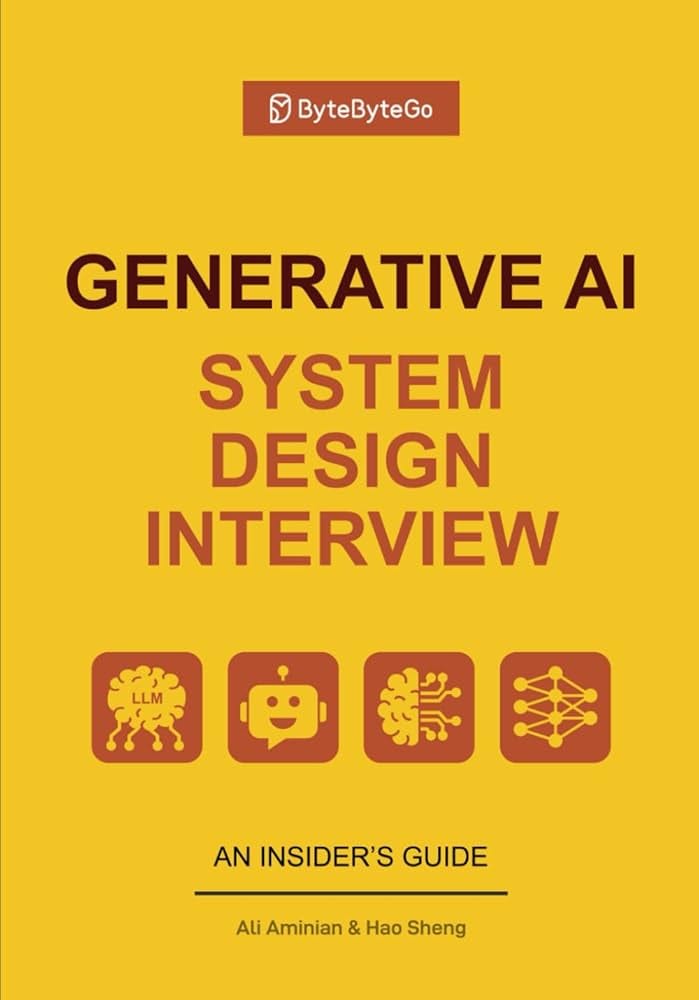
In 2026, most AI roles require GenAI system literacy. This book accelerates that fluency.
If you’re building copilots, internal knowledge bots, or autonomous agents, this is required reading.
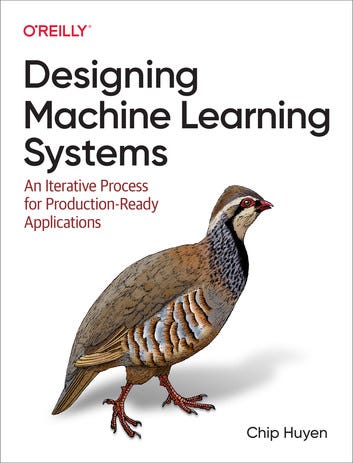
4. Designing Machine Learning Systems – by Chip Huyen
This is lifecycle thinking at scale.
It maps:
Data collection strategies
Labeling workflows
A/B testing frameworks
Evaluation methodologies
Cost control mechanisms
It’s not about “training a model.” It’s about sustaining a product.
For architects and founders, this book builds systems thinking — the skill that separates senior engineers from staff-level leaders.
Why These Books Matter in 2026
AI hype is cheap. Production reliability is not. Here’s where these books compound your advantage.
Production Reliability
Over 80% of ML projects fail post-prototype — not because the model was weak, but because data pipelines broke, features drifted, inference costs exploded, and no monitoring existed.
Huyen’s work teaches monitoring loops that detect silent degradation — especially crucial in LLM systems where hallucinations aren’t obvious until customers complain.
In agentic systems, failure modes multiply. Observability is no longer optional.
These books simulate high-pressure, FAANG-level prompts and teach you to estimate throughput under traffic spikes, design sharding strategies, optimize caching layers, and justify infra decisions.
They convert abstract ML knowledge into defensible architecture.
Even if you’re not interviewing, this mental training sharpens your design instincts.
Scalability Patterns That Save Months
These books emphasize reusable blueprints that can cut system design time by 50%:
Vector stores for retrieval
Ensemble evaluation loops
Online/offline feature stores
Canary releases for ML
Feedback-driven retraining pipelines
In the agentic era, where reasoning chains resemble structured orchestration pipelines, these blueprints underpin modern AI systems.
Career Acceleration Through “System Language”
The biggest unlock isn’t technical. It’s fluency. When you can speak clearly about latency budgets, inference scaling, data contracts, cost per 1K tokens, and eval benchmarks, you move from engineer to leader.
Founders pitching VCs need to articulate AI infrastructure defensibility.
Staff engineers need to justify architecture decisions.
Product leaders need to understand trade-offs before committing roadmap resources.
These books build that vocabulary.
Extracting Maximum ROI From These Books
Don’t just read them.
Recreate one system diagram per week in a notebook.
AI in 2026 is dominated by multi-agent systems coordinating across tools, long-context reasoning models that can sustain complex chains of thought, retrieval orchestration pipelines that ground outputs in dynamic data, and cost-sensitive inference strategies that optimize every token and millisecond.
Yet beneath all that architectural complexity lies a simple, enduring truth: great AI systems are great software systems first. Reliability, observability, scalability, and clean design still win.


![AI Engineering [Book]](https://substackcdn.com/image/fetch/$s_!tJyX!,f_auto,q_auto:good,fl_progressive:steep/https%3A%2F%2Fsubstack-post-media.s3.amazonaws.com%2Fpublic%2Fimages%2F007718d7-cf53-4d49-b0b0-222473e5d549_300x394.jpeg "AI Engineering [Book]")